Category: Modernity

  • Young US men are joining Russian churches promising ‘absurd levels of manliness’


    “A lot of people ask me: ‘Father Moses, how can I increase my manliness to absurd levels?’”

    In a YouTube video,[1] a priest is championing a form of virile, unapologetic masculinity.

    [1]:

    Skinny jeans, crossing your legs, using an iron, shaping your eyebrows, and even eating soup are among the things he derides as too feminine.

    (more…)
  • Dugin: Trump, the Global Deep State, and the Split of the West

    https://twitter.com/PaideumaTV/status/1927274846276223326

    Alexander Dugin traces how Donald Trump’s return to power marks a decisive rupture with the global deep state, fracturing the collective West and hastening the rise of a multipolar world as liberal globalism begins to collapse.

    With the arrival of Donald Trump and his team in the White House, the entire architecture of international relations began to shift—radically so. One of the most important developments in this new global picture is the accelerated fragmentation of the West. Much has been said and written about it, yet this phenomenon still lacks a thorough geopolitical and ideological analysis.

    First and foremost, the split of the West is ideological in nature. Geopolitical aspects are secondary. The point is that Trump and his supporters—who won the U.S. election in the fall of 2024—are radical opponents of liberal globalism. And this is not a passing or partisan issue. It is a serious and principled matter. The current head of the White House bases his entire ideology, policy, and strategy on the central thesis that the left-liberal ideology, which dominated the West (and indeed the world at large) for several decades—especially after the collapse of the Warsaw Pact and the USSR—has completely exhausted its potential. It failed in its mission of global leadership, undermined the sovereignty of the United States (the primary engine and general staff of globalization), and now must be decisively and irreversibly rejected.

    (more…)
  • When it comes to food, there is only one country that is self-sufficient

    … across 5 major nutritional categories, and it’s not any of the big ones.

    poor + enough production to feed its own population is rare

    We all know this ends badly….

    https://www.sciencefocus.com/news/only-one-country-produces-food-it-needs-self-sufficient

  • Ice Sheet Collapse May Come Early

    https://www.msn.com/en-us/weather/topstories/the-world-s-ice-sheets-just-got-a-dire-prognosis-and-coastlines-are-going-to-pay-the-price/ar-AA1F8mbe

    Me: Article is over optimistic. It is essentially impossible to keep +1.5 C limit because we’ve already dialed in more than that. The bad news will hit in 2030-2050 time frame. This is one reason I supported Nuclear Breeder Reactors, back in the 80s — it was the only realistic way to cut back on C02 without killing lots of people in a die off (which would get political opposition or revolutions, even if some people thought self-genocide was ok as long as they stayed in power)

    We rowed up this creek for 50 years and now we are out of paddle.It didn’t help that the academics decided to lie and grift about this stuff, and muddied the waters, but no substantive change was going to happen except we could have run the grid with Pu-239 (not U-235 — there isn’t enough of it)

    If we’d turned off the fossil fuel and gone 100% nuclear asap in 1985, we’d already be past known reserves… ‘Peak U-235’ could have substituted for ‘Peak Oil’ but we’d still have had a problem ca. 2007-2027

    1. AMOC Time

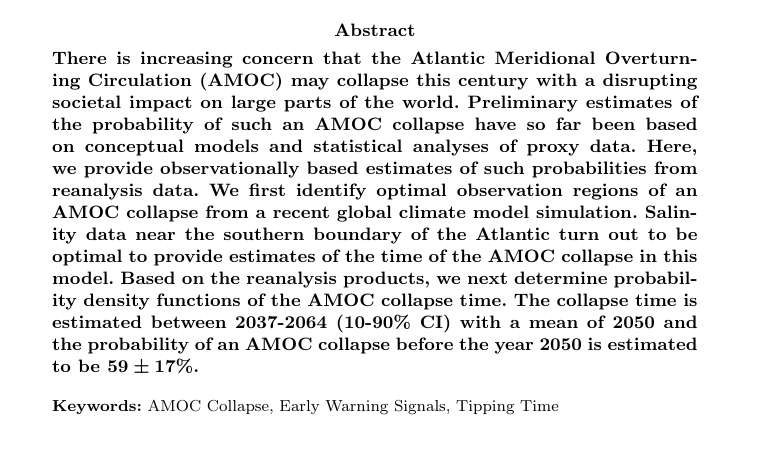
      Not to be bearer of bad news or anything… https://export.arxiv.org/abs/2406.11738

      That’s actually the good news … 50% chance we make it to 2050 before this happens. What’s the bad news? Pre-print from last month: https://arxiv.org/abs/2504.20002

      Review article from 2019: Stability of the Atlantic Meridional Overturning Circulation: A Review and Synthesis – Weijer – 2019 – Journal of Geophysical Research: Oceans – Wiley Online Library

      TBH, there are opposing viewpoints: OS – A 30-year reconstruction of the Atlantic meridional overturning circulation shows no decline

    2. Democracy Vouchers

      Democracy Vouchers | Phora Nova

      First I’ve heard of this plan (which originated across the water in Seattle, ca. 2017)

      I get the pitch:  ‘democracy vouchers are just like school vouchers, so “conservatives” should like that and fall for it’ — and it will help fund socialism’ … but in its current Liberal mode, not any real sort of Socialism.

      In a sane world, the YOG courts would strike this sort of thing down as unconstitutional civil rights violations under the Occupation’s fave, ‘the equal protections clause for Civil Rights’ — the reason is that property owners, who presumably pay taxes to create public funding for political campaigns at the local level (just like they do for mandatory school indoctrination programmes and institutions), are a class of people and not being equally taxed here.  Their money payments are transfered directly to mob politics and will create two feedback loops: 1/ those in power can try to manipulate (‘harvest’) the vouchers, similar to who joint-stock corporations and their boards and managers manipulate ‘proxy voting’ among stockholders.  2/ it creates a possible revolutionary dynamic for the anti-thesis ‘outties’ to do street theatre and stage a revolution.

      That’s without even thinking about the proposal for more than 5 minutes.

      I think in any event that like ‘public education’, any such scheme would have unintended consequences, and in the medium term become just one more entrenched programme with institutional clients handing out goodies to people who had no part in creating the wealth being distributed.  Direct dictatorship by the Proletariat would be preferable — at least factory workers make things.

    3. Greer on Peak Oil

      The Fall and Rise of Peak Oil – Ecosophia

      tl;dr is the conclusion:

      What we can expect, though, is something far more terrifying to most people than the most lurid disaster a Hollywood screenwriter ever imagined: more of what we’ve already seen. The long, slow, unsteady descent that’s shaped all our lives for the last half century or more? That’s going to continue along the trajectory it’s already following, for the rest of your life, and into the lives of your grandchildren’s grandchildren.

      In the light of that longer view, it doesn’t especially matter who’s in the White House, or for that matter who’s in the doghouse. It matters very little more which policies get put in place and which policies get chucked in the dumpster. There are still things that individuals, families, and communities can do to brace themselves for the future ahead, and some of those things are very important—we’ll get to them in future posts. None of these will affect the overall course of this nation or of industrial society as a whole. That train left the station long ago. Listen carefully and you can hear the distant whistle on the wind, fading to silence.

      That doesn’t mean the fine details of the future are fixed in place. I predicted, some years ago, that the next energy crisis would arrive sometime around 2022. That didn’t happen, because we got the Covid crisis instead. Many of the same economic and social disruptions that took place following the dramatic spike in petroleum prices in 2008 had close equivalents in 2021 and 2022, and energy usage lurched downward in a very similar manner as air travel, commuting, and many other energy-intensive activities decreased. That bought some time. The Trump administration’s push to remove regulatory barriers to oil and gas drilling may buy a little more, though that will depend on variables that aren’t yet clear, and will have cascading downsides of its own. As a very rough guess, I think it’s possible that we’ll see another energy crisis (or some comparable disruption with similar effects) before 2030, and fairly certain that we’ll get one before 2035.

      The fine details will have to be worked out mathematically by those who are adept at such things, the way Colin Campbell and his associates did in the early days of the peak oil scene, back before 2000. Fortunately there are still some active peak oil aggregator sites and blogs; you can find a more or less current list here[1]. I encourage my readers to visit them and start getting familiar with their contents. We’ll be talking more about peak oil later on—after, that is, we talk about some of the other factors that are pushing our civilization down the same well-worn chute. In two weeks we’ll turn to another of those, and talk about what’s been happening to the climate.

      – 30 –

      [1]:

      https://www.ecosophia.net/blogroll-of-doom/

      My comment:  analogies between the financial collapse of 2007/2008 and early COVID are underrated.  The only decent treatment I know is:

      M&B Lectures | Perry G Mehrling  (the nitty gritty)

      and a short blog:

      https://sites.bu.edu/perry/2021/05/19/new-lombard-street-ten-years-on/

      Here is a web archive for the last ASPO website (2007ish)… apparently their last conference was in 2012.

      https://web.archive.org/web/20080807163431/http://www.aspo-global.org/
    4. Charles Hugh-Smith: The Terminal Rot in Corporate America

      https://charleshughsmith.substack.com/p/the-terminal-rot-in-corporate-america

      One of humanity’s most pernicious traits is the ease with which we habituate to conditions over time that we would have rejected out of hand if the transition had been sudden. This is the essence of what I term Anti-Progress: over time, what was solid melts away into thin air, what worked no longer works, but we no longer notice because wretchedness and decay have been normalized, i.e. accepted as “the way things are,” or hyper-normalized: everyone knows things no longer work but we’re unable to change the system, so we play-act that everything’s fine as a means of not going crazy.

      Which brings us to the terminal rot in Corporate America, a rot so deep and pervasive that few recall that Corporate America once had some purpose other than increasing profits next quarter to boost “shareholder value.”

      The moral rot in Corporate America goes unnoticed in a society in terminal moral decay. Why should corporate fraud, profiteering, deception and extortion attract our attention when self-service is the norm, lobbyists write regulations, legislators tell us we’ll find out what’s in the bill after they pass it into law, tax fraud by the wealthy is accepted practice, and so on in an endless stream of avarice and corruption?

      Rest at the link.