Category: Circle of Crust

  • Merry Christmas A.M. 7534

    Today in all calendars

    The Roman Imperium: Two Divisons Today? | Page 2 | Phora Nova

    I’ll try to reiterate and extend some comments on this topic that I’ve made before.

    I usually start (as is my habitual method) with etymological analysis.  What is Sovereignty?  (Over-kingship – who or what is above the King, even the King of the World?)  As a word, it is a very Western/Romance/Romantic one, and would be hard to translate into either Latin or Greek.  ver

    Looking back into the Roman Imperium, we see that Romanity (the set of all Roman things that is Romanitas, including all tribes loyal to Rome), has an ethnic and social structure, as I’ve mentioned before.  The Romans themselves had two large divisions of Citizenry, Quirites (Sabines) and Romani themselves.  Then of course they had a tribal structure, and within those tribes gens or Clan, and groupings of clans on the Aryan model which they shared with the Greek tribes — Phrateries.  And then, within the Clan, a very finely organised famly structure of persons related in known fact, not just in legal theory or distant antiquity, which comprised the private, domestic side of Life lived-out within Romanity.

    Finally, there was a City-State (a polis or political entity), within which there was exercised the legal notion of Imperium.  That is, Patriarchy at the domestic level, Romanity at the state level, and Orthodoxy at some higher level that needs discussion but we may call Religious or Spiritual for want of more exposition.

    In modern times, that higher level is the Nation-State, which emerged with their Catholic Majesties in Spain, and King Edward IV Plantagenet (?) in England, in the late 15th century of the West.  Like the medieval notion of ‘sovereignty’, it is a purely Western one, though with a certain relation to the conceptual framework of Romanity as used in the (then heretical) West.  In ancient times, there was likewise a notion of The Oikoumene — the ‘dwelling lands’ that were entirely conquered by Alexander the Great and his successors, including those in Palestine, which is where the connection between the Greek world (of the Hittites, Myceneans, and Kings of Tarshish, and the Sea-Peoples) mixes up with the Egypt-Mesopotamian-Iranian cauldron.  It is the context within which such terms as Episcopal (over-seer, itself related to a kind of Sovereignty), and Church (Ekklesia, a call out of men-in-arms for a city-state), as well as the notion of ‘an Ecumenical Empire’ ruled by Despotai and The Great King, comes from.  (The word Baliseus was the Greek translation of Agustus, and so we pray for the Two Vasilefsi in Greek, and doubtless the same in Russian, as their role of defending the borders of the Oikoumene — the Imperial Household — from the Barbarians at the Roles.  That is, they are Catechons.)

    We must say something proper about how the Roman Imperium — the Greek word is Politeuma, as a Res Publica — and thus Constantine founded the *Christian* Politeuma, with a universal mission to extend the Oikoumene to the Ends of the Earth (or is it the Kosmos?).

    I point out this term, Respublica Christiana because it forms the legal theory for lawful action in the West.  That is, the nation-states of Europe *understood* they were part of the Politeuma of Constantine (and why would the ‘Donation of Constantine’ matter to them, if they were not?)  This is well-discussed by Schimitt, and other 20th century scholars on the topic of the Kings Two Swords, the notion of Sovereignty in Early Modern Europe, etc, which need not detain us.  The origin and history of such notions since *derived* from the ‘Constantinian Entity’, whatever status you give that, is quite clear.

    I must be clear however that I am not talking *just* about Institutions but also Peoples and The Body of Christ.  These notions must be carefully related.  The Latin words ‘con-stitutio’ and ‘in-stitutio’ have very specific meanings related to the sort of Legislation a Great King (basileus) or Augustus, might do.  In particular, the ‘Constitutions of Justinian’ is a term of legal art.  The decrees of an Augustus are for the Whole World, not just our modern notion of Federation — a treaty between severally but mutually sovereign entities. 

    Societies, from City-States to the religious and spiritual society of the Body of Christ, persons incorporated in a single Person having the Mind of Christ (the Church), to, coming down a bit, modern Nation-States and Empires, all have *institutions*.  These institutions or arrangements are *organic*, that is they function as organs of the body, but that does not mean they don’t sometimes, die, need to be replaced by new or similarly functioning ones, or even that they are identically constituted in different parts of the same organism — one may have two kidneys, or only one, and if two they might differ in various ways, or even one can be natural, and one artificial.  Yes there must *be* such institutions, and they must function ‘for the Life of the World’, in the highest case.

    The Roman Imperium — the command of a magistrate, duly following the cursus honorem established and instituted in the Constitution of the Empire for such things, as Questor, Praetor, Consul, many such cases.  And many other duties and offices of men.  The Roman Imperium I say is the right of command of some magistrates, as has been instituted lawfully in the Res Publica Christiana, and is exercised today in the National Offices for which we pray, whether that office is filled by a heretic or an Orthodox believer, and to the extent it is not Anti-Christ, making war on God and siding with Satan, as will increasingly happen as the World (the Universe itself) Ages.

    Speaking then, of which,  When Augustus Ruled the World Alone…

    MERRY CHRISTMAS A.D. 2025 / A.M. (Etos Kosmou, In the Year of the Kosmos) 7534
  • Greer on Situationalism

    Greer on Wagner and the After Times We Live In | Page 2 | Phora Nova

    Greer is chipping away at his ‘Situationism’ theme, and finally (in the last month) has gotten to his point.  I was wondering if he would do the ‘big reveal’ — that Marxism (and indeed Liberalism and Fascism) are sorts of POLITICL ALCHEMY.  Alchemy being the materialist twin of Astrology — as above, so below.

    Indeed he is going there — there are must read, must discuss.

    In particular, after sketching the ‘Beatniks’ (parents of what we now call Redditors[1]), and 60s era Marxist follies, he gets serious about why the Situationists in the 60s *failed* to follow the pre-ww2 insights of the Surrealists — where Evola and Marxism meet, you might say.  He says, explicitly, that they do not want to, into Occultism, i.e. the sort of dabbling Greer is into, which I think, though I have not read those works of his extensively, amounts to a fairly straightforward Neo-Platonism with a practice along New Dawn lines.  I would add, perhaps the Situationists, the Inner Party of the Marxists, are reserving that for ‘inner adepts’, in the grand Straussian style…

    I have reprinted the final paragraphs of the first piece for us to see ‘where this is going’.

    [1]:

    +

    https://tunisbayclub.com/index.php?threads/reddit-man-anthropology.3167/#post-32289

    —–

    Situationism: Where Domination Ends – Ecosophia

    Situationism: The Road from Raswashingsputin – Ecosophia

    That transmutation runs all through Vaneigem’s book, and through Situationism as a whole. When Marx wrote of alienation, for example, he had in mind the removal of control over the means of production from the laboring classes by a succession of governing classes. When Vaneigem and his fellow Situationists wrote about the same theme, they refocused the discussion on the concrete personal experience of alienation, of the inner state of the individual who feels cut off from his or her own sources of meaning, value, and power. Look closely at every other central concept of the avant-garde Marxism of the time as it appears in Situationist literature, and you’ll find the same alchemy at work.

    That was the great achievement of the Situationists, but it also endangered their status as loyal beta-Marxists serving the bureaucratic system against which they claimed to rebel. Recognize the subjective dimension of alienation and you open the door to responses that can actually affect the situation: responses that have the potential to move past the point at which domination falters and freedom comes within reach of the individual. Once these responses are understood and the necessary skills have been developed, the bureaucratic system has no effective defenses against them. The downside of this subjective approach is that these steps can only be taken by the individual for himself or herself. Nothing is more futile, or more certain to end in exploitation and defeat, than waiting for someone else to do it for you.

    Furthermore, there are sharp limits to how much help you can give anyone, even if they want to follow your lead. Situationism, interestingly enough, included several of the core methods that can be used to assist that process. In future posts here, I’ll talk about the crafting of situations, the art of the derivé, and the practical tactics of détournement, which provide a good solid toolkit both for the individual pursuing autonomy and for the experienced practitioner hoping to show the way to novices. Even so, the original impetus and the follow-through both have to come from the individual. Thus the movement toward freedom can never really be a mass movement. It can only be a movement of individuals in opposition to the mass.

    I’m pretty sure the Situationists themselves were aware of this. The way that certain patterns of Marxist rhetoric repeat in their writings like so many nervous tics suggests, at least to me, a sustained effort to back away from the implications of core Situationist concepts, and hide from the challenge of individual liberation behind the old failed dream of mass revolution followed by sentimental fantasies of utopia. More revealing still, though, is the extraordinarily ambivalent attitude the Situationists displayed toward the Surrealists, who in many ways were their most important predecessors. While some of the core Situationist writings acknowledged their debt to Surrealism, those same writings also rejected Surrealism root and branch.

    That rejection was no accident. Some of the Surrealists, in their own ways, reached some of the same insights before the Second World War that the Situationists grasped after that war, but many of the leading figures in the earlier movement followed those insights into territory where the Situationists would not follow. For a significant number of them, their quest for the place where domination ends led them to occultism. We’ll follow them there in due time.

    – 30 –

    My reaction:  well said, though I don’t think Marx is a foil for ‘Political Alchemy’ nor is Lenin, of Occult Materialism or dare we say DIALECTICAL Materialism.  They were both practitioners of the highest order.

  • US Changes National Security Strategy

    US Changes National Security Strategy | Phora Nova

    [URL unfurl=”true”]https://www.zerohedge.com/geopolitical/new-national-security-strategy-surprise-departure-americas-china-policy[/URL]

    Authored by Arnaud Bertrand via The Ron Paul Institute

    In a big development, the final US National Security Strategy was just published and the refocus on the Western Hemisphere (i.e. the Americas) is confirmed. The document clearly establishes this as the US’s number one priority, saying that the US will now “assert and enforce a ‘Trump Corollary’ to the Monroe Doctrine.”

    In terms of military presence, they write that this means “a readjustment of our global military presence to address urgent threats in our Hemisphere, and away from theaters whose relative import to American national security has declined in recent decades or years.”

    On China, a couple of points…

    The most striking aspect to me is that China is NOT anymore defined as “the” primary threat, “most consequential challenge,” “pacing threat,” or similar formulations used in previous such documents.

    It’s clearly downgraded as a priority. Based on the document’s structure and emphasis, the top U.S. priorities could be characterized as:

    1) Homeland security and borders (migration, cartels, etc.)

    2) Western Hemisphere (Monroe Doctrine restoration)

    3) Economic security (reindustrialization, supply chains)

    4) China and Indo-Pacific

    To be clear they don’t define China as an ally or a partner in any shape or form but primarily as:

    1) an economic competitor;

    2) a source of supply chain vulnerabilities (but also a trading partner); and

    3) a player who regional dominance should be “ideally” denied because it “has major implications for the U.S. economy.”

    Interestingly, I believe for the first time ever, they mention the possibility of being overmatched militarily by China. They write that “deterring a conflict over Taiwan, ideally by preserving military overmatch, is a priority” – but “ideally” clearly means that it’s ideal, but not necessarily a given.

    Via Anadolu Agency

    The fact that they call deterring conflict over Taiwan merely “a priority” also suggests, by definition, that it’s no more a top strategic priority, or a vital interest. On Taiwan they also clearly imply that if the US’s “First Island Chain allies” don’t “step up and spend – and more importantly do – much more for collective defense,” then there might be “a balance of forces so unfavorable to us as to make defending that island impossible.”

    They still maintain that “the United States does not support any unilateral change to the status quo in the Taiwan Strait” but, clearly, there’s a widening gap between what the US says it opposes and what it’s actually willing to do about it.

    Interestingly as well, contrary to previous such document, there is zero ideological dimension in the document when it comes to China. No “democracy vs. autocracy” framing, no “rules-based international order” to defend, no values-based crusade. China is treated as a practical issue to be managed, not an ideological adversary to be defeated.

    In fact the document explicitly mentions, I think for the first time ever as well, that US policy is now:

    • “not grounded in traditional, political ideology”
    • that they “seek good relations and peaceful commercial relations with the nations of the world without imposing on them democratic or other social change that differs widely from their traditions and histories.”
    • and that they seek “good relations with nations whose governing systems differ from ours.”

    …Which is quite a stunning departure from the rhetoric of the past few decades. We all knew this but it’s now amply clear that the era of missionary liberal internationalism in US foreign policy is dead and buried.

    The competition with China is primarily described in economic terms, explicitly so: they write the competition is about “winning the economic future” and that economics are “the ultimate stakes.”

    Notably, they admit that the tariffs approach “that began in 2017” when it comes to China essentially failed because “China adapted” and has “strengthened its hold on supply chains.”

    The new strategy, as described in the document, is to build an economic coalition against China that can exert more leverage than the US economy alone – a tacit admission that America just isn’t powerful enough on its own anymore.

    The contradiction is however obvious: it is unclear how you build an economic coalition against China while simultaneously waging trade wars against your coalition partners, demanding they shoulder more of their own defense, and treating every allied relationship as a deal to be renegotiated in America’s favor.

    At some point these “allies” will be asking a very obvious question: why sacrifice our economic interests to prop up an America that can no longer compete on its own – and that offers us less and less in return? The document can be found here.

  • Bidenomics? Neoliberalism worked pretty well, actually

    Article posted for reference and discussion, not approval.

    https://archive.ph/ZXP4P#selection-1205.0-1205.42

    Neoliberalism Worked Pretty Well, Actually​

    Yes, the market-driven economic policy of the last several decades left too many behind, but it also spurred historic growth.
    June 10, 2024 at 11:00 AM UTC
    By Allison Schrager
    Allison Schrager is a Bloomberg Opinion columnist covering economics. A senior fellow at the Manhattan Institute, she is author of “An Economist Walks Into a Brothel: And Other Unexpected Places to Understand Risk.”

    Somehow it has become conventional wisdom that neoliberal economics was an abject failure. Like a lot of conventional wisdom, this is wrong. Not only has neoliberalism been a great success, but now is exactly the wrong time to reverse it.
    That hasn’t stopped the bipartisan consensus from forming. Noting that neoliberal economics “left many working Americans and their communities behind,” one of President Joe Biden’s top advisers claims that the administration is pioneering a new industrial policy defined by tariffs and subsidies. Donald Trump promises similar policies, and would even take them up a notch.

    The first problem with these critiques is definitional. Neoliberalism does not mean a strict adherence to free markets, the abolition of state intervention and a cult-like devotion to Milton Friedman. Yes, beginning in the 1970s, there was a general decrease in marginal tax rates, an increase in free-trade agreements, and easier flows of international capital. The so-called “ Washington consensus ,” fostered by institutions such as the International Monetary Fund, preached the benefits of less debt, more trade and reduced government intervention.

    (more…)
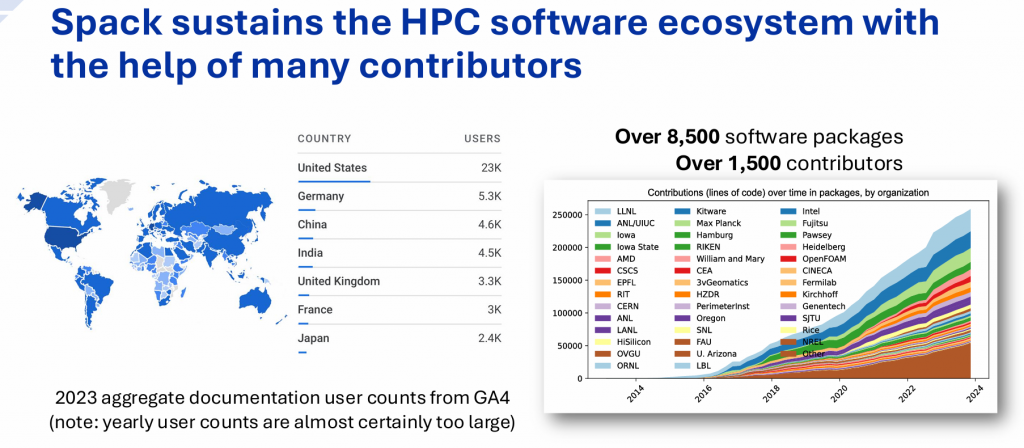
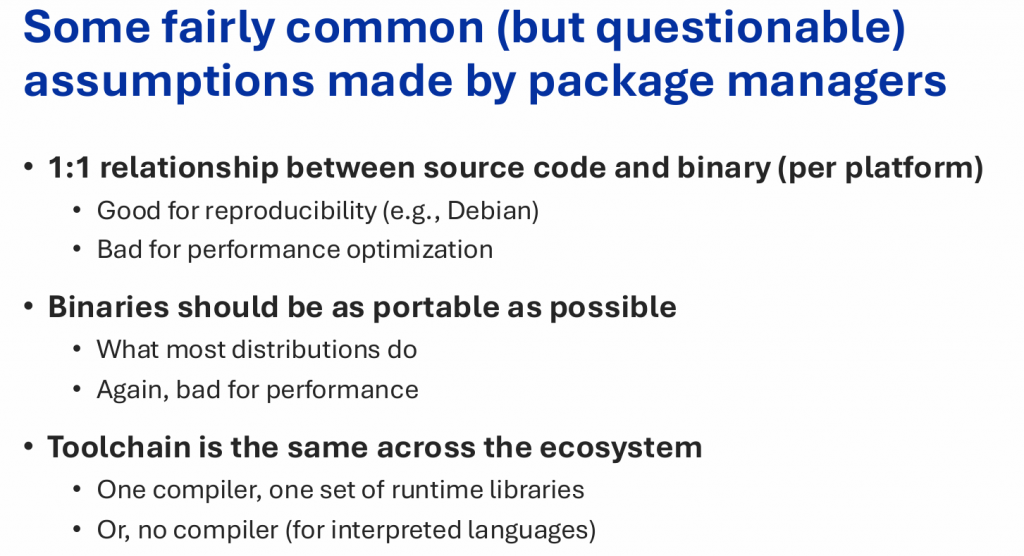
  • The Spack Eco-System

    High Throughput Computing (HTPC) and High Performance Computing (HPC) are not the same thing, computationally. Current business models are more focused on processing large volumes of data (‘Big Data’) rather than doing intense computations on them.

    AI tips this balance. This has implications all the way down the build chain to platforms, compilers, packaging systems, etc.

    Here are three slides that occur early for the tutorial on

    Spack Tutorial documentation

  • Macro’s Economics: Predictions for 2026

    Back in December 2024 I made predictions for 2025-2026 along the lines of what in business intelligence/marketing is called ‘Environmental Analysis’ (of the competitive business space).  This often goes by the acronym PEST Analysis, for Politics, Economics, Sociological factors, and Technology.

    Macrobius Makes Predictions for 2025-2026 | Phora Nova

    I did P pretty thoroughly, leaving the rest for later … hey, I had 1-1/2 years to make calls for Midterms, right?

    A little later, I did the T:

    Where is Technology going, 2025-2026 | Phora Nova (April 2025)

    Programming as we know it will disappear this year | Phora Nova  (Mar 2025)

    T was hard to call in December, but after DeekSeek (January) and Agentic AI, it was pretty clear which problems were going to be solved and how *if* they were going to be solved before 2027.

    This lead to a fairly solid prediction that the Economic and Social outcomes were going to be very dependent one the building of power infrastructure (and then, we had some grid collapses to give us a taste of coming attractions).  A few factors are missed in the ‘public narrative’ for the most part — one is the continuing drop in male sperm rates, and what that implies for demographics in technological societies, and the other is the possibility of an ‘extinction attractor’ related to the use of AI technology, the so-called ‘Singularity’.  We shall have to say something about these, but they will not be dominant in our 2026 prediction window.

    P wasn’t so bad — it was very clear that we were in the midst of the ‘Polycrisis’ and that the slow social learning around Peak Oil, Anthropogenic Global Warning, the fate of Globalism and the ‘Global Supply Chain’, as well as the general direction of Geopolitics,

    Of course now we know, which no one did in December 2024, that Trump and Vance were in *fact* going to be seated, and how that was going to go down, and what sort of policies, as opposed to campaign promising, were really going to be initiated.  Now, eight+ months later, we have a pretty good idea of the political battlespace, with much more certainty than we did when the Old Man handed over the keys to the kingdom to the Little Baby that was 2025, in Time Square at midnight.

    In this thread, I am going to flesh out E and S (and hopefully be done before the beginning of 2026!)

    Short form:  E is now utterly dependent the answer that Neo-Liberal Capitalism and its Oligarchs have decided to give to the Polycrisis and Immigration:  attempt to bring down the cost of Labour by using ‘Artificial Intelligence’ and in any event building out the Power Grid, both Nuclear and Solar, for various reasons only some of which are the big bet on AI.  Both E and S are going to depend, therefore, almost exclusively on Herd and Network effects.

    We need, first off, to spell out where Herd effects *come from* and why they are important to both to the polycrisis (the power grid and logistics that depend on it), and to Artificial Intelligence.  That is, how are Energy and Information Theory related?

    To make clear where I am going with this, let us consider bitcoin, and a conjecture of mine–I will call it a conjecture, not a hypothesis or observation, because someone really should prove this from first principles in an economic model.  Maybe that someone should even be me.  But anyone can make …

    The Macrobius Bitcoin Conjecture:

    > Proof of work gives you the minimum energy cost, needed to force the blockchain distributed system from the babbling equilibrium into the truth-telling equilibrium.

    I suppose I shall need to explain what a babbling equilibrium is first, though we certainly had experience of that in the 2024 Election Cycle.