Future home of summary analysis related to https://thephora.net/phoranova/index.php?threads/scientific-analysis-of-nuclear-site-effects-in-iran.2042/
Author: Macrobius
-
Coughlin on War Powers
Interesting take and excellent points, as always, from S. Coughlin: https://twitter.com/S_Coughlin_DC/status/1936727565269393741
Quoting:
There is nothing in the Constituion that ever said that the Presidents execution of his Article II powers was contingent on Congress declaring war.
War is a legal status that can (and usually does) involve the use of militay force. Short of that, the President has some discretion on the use of force short of war.
When TR launched the USN’s Great White Fleet (b/c Great Britain’s Royal Navy was black), Congress only gave him enough funds to keep the navy operational. So, TR sent the navy to the other side of the world and told Congress that if they want the Navy back, they better cough up the funds.
Congress controls the purse. That’s their leverage. This debate, always a kabuke, always plays out this way.
– 30 –
The War Powers Act is Congress’s take on its own powers, born at the height of Democratic Party / Neo-Liberal power, just after the Vietnam War, and just before the Nixon Coup.
https://en.wikipedia.org/wiki/War_Powers_Resolution
The Constitutional question has never really been put to the test.
The president is the ‘monarchical principle’ of the state, our Sovereign in effect, and the president can make war. As with the Stuart Absolute monarchs, the primary restraint on the King by Parliament is the power of the purse. Our constitution is very similar to its model, the British constitution, in this regard. [There are better theories of the relation of King to the Magnates and People, in a Zemsky-like Sobor, of course, but I am speaking of Anglo-American political theory here, in its Whig and Tory variants. Our variant in North America was the *Continental Congress*]
Another thing found nowhere in the constitution: that Congress has the power to *compel* the Executive to either spend all monies voted to it, or to prescribe in detail how those monies are to be spent, in a way that limits executive power so that it cannot function.
-
Science Newsfeed 201332TJUN25
https://edition.cnn.com/2025/06/18/climate/food-crops-heat-rain
https://www.nature.com/articles/s44221-023-00040-5.epdf paper for above online only
https://www.science.org/doi/10.1126/sciadv.adu8826
-
Chats at the Saturnalia Substack
These never got much traction, but as they are in the MacroVerse I thought I’d retain an index of them, since they cover the usual set of topics discussed at Whitespace
About 27 chats of note:
Ouspensky on the Russian Revolution
https://open.substack.com/chat/posts/2242a203-3749-4372-9ff0-37b6647363dcDread of Dugin
https://open.substack.com/chat/posts/7b1d22f4-9c11-40d8-a618-71d9edaeb3ebThe Clauswitzian Triangle
https://open.substack.com/chat/posts/f7af65cf-6b8d-4c7b-87bd-0e2029f8c176The American Republic is in Great Danger
https://open.substack.com/chat/posts/0b96539c-77d7-4963-b63e-9e324707053fClassical America (Ziobro link)
https://open.substack.com/chat/posts/c08542fc-b559-4980-b923-fae50cac37afThe Aristotelian Curriculum from an Islamic Point of View
https://open.substack.com/chat/posts/be68d1f0-eed1-49c8-bf82-ce2d1f8afcccSt Thomas Aquinas Book Collection
https://open.substack.com/chat/posts/bc8eba66-d23d-46db-a050-133d7740c68dMilitary Handbooks
https://open.substack.com/chat/posts/b464cadc-3b45-4395-955e-53fead9519d5Covenants in the Bible
https://open.substack.com/chat/posts/48eff394-0241-496b-930e-0882d33b879cThomist Writings
https://open.substack.com/chat/posts/9547e863-5ae1-4c2f-9c0a-1bc9effb2abeHow Scotland Invented the Modern World
https://open.substack.com/chat/posts/98fa4b07-61c8-470e-9f75-4be6447bb4e9On Hegel: A Study in Sorcery
https://open.substack.com/chat/posts/1c87e32a-d4c0-4461-b564-b2093926c93cQuantum Mechanics
https://open.substack.com/chat/posts/4198022d-c6a4-4086-af0e-1d942ea16482On RFK
https://open.substack.com/chat/posts/a5b7e3e3-b303-455d-b3a2-cd81562ec476Vortigern Studies
https://open.substack.com/chat/posts/170eaf81-8dd7-4c88-b2d8-25374b896c12The ChesterBelloc
https://open.substack.com/chat/posts/7efda9b1-5ef9-4953-b19a-381c21b48196Cousins Wars: An Essential Book
https://open.substack.com/chat/posts/dd9dbe19-8204-4796-9336-6e3f0d50b87cBamberg Co
https://open.substack.com/chat/posts/9d9953b6-f16a-4247-a5f9-dcdc6094bbe5Influence of the Scottish Enlightenment on the American Revolution
A long rambling thread on the influence of the Scottish Enlightenment on Thomas Jefferson (mostly) and other Founding Fathers, along with a favourite topic — the library of Mr Jefferson’s that he sold to form the core collection of the Library of Congress, in 1815.
https://twitter.com/weremight/status/1769440682786304063Garrigou-Lagrange on Common Sense
https://open.substack.com/chat/posts/fb232855-9803-4cbc-97b8-4fd6ee1bdbacVogelin on Aristotle
https://open.substack.com/chat/posts/ec479aa5-3c74-4ccc-b36f-89a4866cd2bdWas Uhtred Real?
https://open.substack.com/chat/posts/fb696ebf-1fe4-4457-9320-d3120c34f502Liberty Fund Books
https://open.substack.com/chat/posts/614a9418-322c-43c7-8b4a-1eac2e014420Writings of James Wilson
https://open.substack.com/chat/posts/afd8b803-8c21-4601-bafa-ddfae3c37eb0Re-inventing the E-zine on Twitter
https://open.substack.com/chat/posts/26cfb546-756a-4e0f-9e0b-923a5635a7b3Topics from The Palmer Worm
https://open.substack.com/chat/posts/ad308015-5f4e-49e1-80d2-3b6b5591b3c9https://open.substack.com/chat/posts/66075bc6-809a-4c98-83b5-5d1eeccdfc99 – Southern Literature Reading Group
-
linuxhippie on the revolution
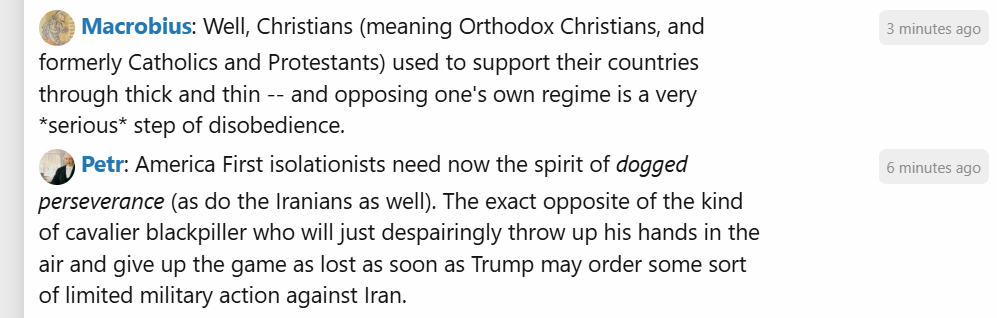
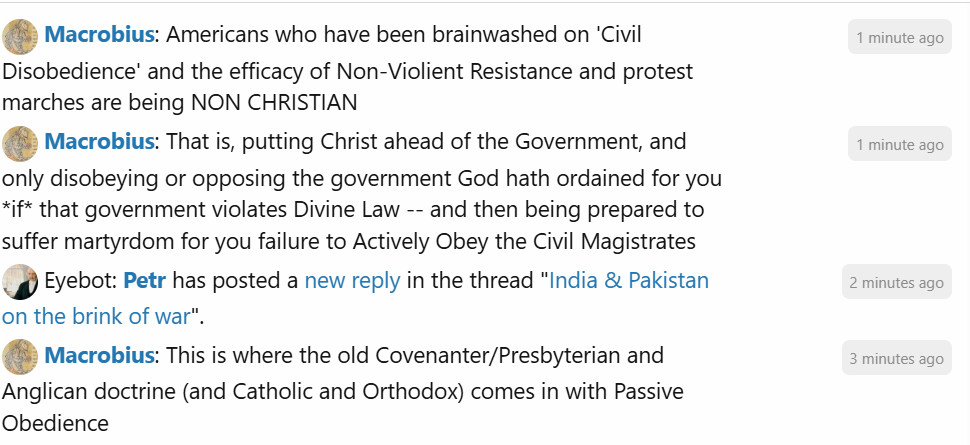
It’s a Revolution dummy. 1) There can be disagreement about what “Legal Term” to use to describe the events unfolding in the United States. Have the “elements of the crime” of Insurrection, Revolt, Sedition, Domestic Violence, or Terrorism been met? I’ll leave that to the Lawyers. But whatever it is, it certainly isn’t a protest or protected speech. Any SF Guy worth his salt knows exactly what this is, Marxist Revolutionary activity. Full Stop. The Protest is the sea the Insurgent swims in.
Judges reference No Kings) to Sen Minority Leader Schumer sponsoring Legislation (No Kings Act) echoing the already “trademarked” and merchandized “No Kings” riots planned for this weekend (to coincide with US Army Birthday celebration—negating it)….. The continued theater by Democrat Politicians about “kneeling” to the executive (they had no problem kneeling for a drug addicted criminal when it suited them btw) and last but not least____THE DEAFENING SILENCE OF THE SENATE MAJORITY LEADER THUNE…….. Are clear indicators that the “Mass Line” has been established and the “Movement” toward confrontation is well underway.
3) It is professionally negligent (to the point of criminal) to not conclude something untoward is afoot. Ignorance that gets in the way of analysis is a sever National Security Threat. People see these riots as noisy and destructive, but no real threat to the Republic. They are wrong. The Maoist Insurgency model has not changed. This doctrine has been rigidly adhered to since Mao developed and successfully deployed it. While certain elements have been “adapted” to modern technology and tweaked to fit the target environment it is essentially the same.
4) Folks calling it “Color Revolution” are adding a level categorization that isn’t necessary, it’s Revolution, full stop. This isn’t 5GW or whatever, those terms serve to obscure what has been an element of warfare since the beginning of organized violence. Deception, distraction, misdirection, confusion, have always played a part in warfare, the advent of computers just provided a new delivery method. We are living through the outcome of removing “Threat Based” analysis from our National Security Organizations and the FORCED conversion to “effects based” analysis that relies on “pseudo-scientific” narratives (ie 5GW blah blah) to dialectically negate our “subjective awareness” of the reality we face.
5) When a Marxist Insurgency being lead by State Gov, City Mayors, and Federally Elected Senator’s and Congressman is allowed to deploy across the Nation….. When those same people are openly calling for Troops (Ted Lieu) to disobey orders “they” deem unlawful (sedition?) and the Senate Majority Leader of the Presidents own Party remains silent……..we have a problem. That problem becomes existential when those who advise the President and provide him counsel don’t recognize it with this level of clarity. The theater with Sec Neom is an indicator (the Sen should’ve been charged) and the march to his office (Thune should’ve thrown them out and warned them they were in violation of Senate Rules)….. Indicate we are right back where we were when last we had a President Trump. The GOPe is the Controlled Opposition (ie they are allowing events by not intervening) and the entire Democrat Party is the violent splinter…..
6) In order to defend, one must know what is being attacked and the what the enemy’s goals are. To be confused about this is to be “Strategically Dislocated” and ensures that responses will likely be “under-inclusive” to the threat and will fail. That is the goal of all this noise, and it’s working. It’s keeping the Admin in a “action/reaction” cycle that the left controls. As crazy as the left “APPEARS” to be on the street, those organizing these events are completely sane and have very clear objectives in mind. They have templated actions to achieve a “minimum success criteria” (a DST Decision Support Template) and are prepared to overachieve.
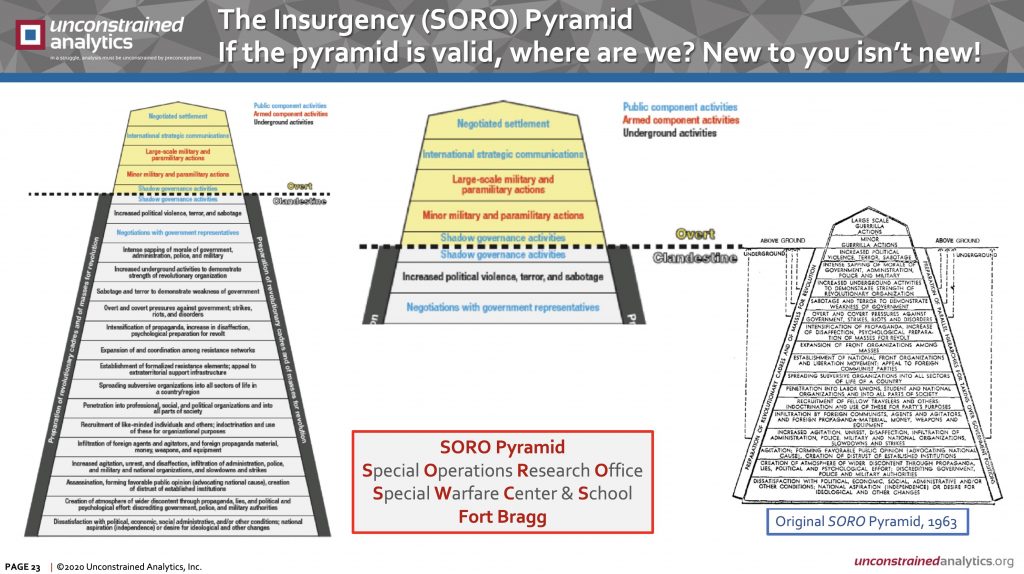
7) “Negotiated Settlement” is always the goal when the Insurgency doesn’t have the combat power to overthrow by force of arms the existing Government. “Dialogue and Praxis” slowly, overtime, erodes the targets ability to generate a coherent defense of what is being attacked. (that’s where we are) Open Communications like “No Kings” is C3 of the resistance movement. They want “legitimacy” and if the Trump Admin continues to be overwhelmed by these “Staged Dramatics” (Neom event) and fails to respond to open defiance of Federal Law by Governors, Mayors, and State/ Local Law Enforcement, they will likely succeed in achieving their minimum success criteria….negation of the current Admin’s agenda and place Trump’s Presidency (that YOU voted for) in jeopardy. (GOP’s goal)
8) So whatever you call it, this sure isn’t a protest. Sen Thune and the GOPe have declared (by their silence) they are siding with the Insurgents. It is up to the population to ensure that the one thing they most desperately want they don’t get, Trump to lose popular support. So as the Admin fumbles around with what is a highly coordinated “Intersectional” attack on the Foundation of Country, the citizens need to be aware of the part they play. Trump loses (or is perceived to have lost) popular support and all bets are off as to what the outcomes will be. It is entirely possible that as President, he doesn’t make it through the summer if the GOPe turns on him openly. THAT my friends, is what all this riot business is about
# # #
-
Unconstrained Analytics Resources
A page of links for later development:
https://twitter.com/S_Coughlin_DC/status/1932884491779051999 (SORO diagrams)
https://unconstrainedanalytics.org/resources/
https://unconstrainedanalytics.org/report-re-remembering-the-mis-remembered-left-the-lefts-strategy-and-tactics-to-transform-america/ (2018)
https://x.com/S_coughlin_dc -
Communication Tuesday 20250612
‘Communication Tuesday’ is a regular feature of internal communications at the LLC I run. I thought I’d reprint them occasionally here, too.
Running a bit late this week… 🙂
We are starting our course on Marketing basics, which is supposed to be delivered as an email correspondence course, to both
Here are some thoughts to get us started:
The purpose of marketing and market research, as well as the preparatiion of marketing materials (flyers, websites, blogs, ‘creatives’ for advertising, etc). is to generate *leads* (email contact addresses) and guide them down the Sales Funnel from 1/ interest to stages of 2/ intent (to buy *something* but we don’t necessarily know what) to 3/ conversion (decision to buy something from us) and finally to 4/ transaction — placing an order, and starting the ‘Customer Fulfillment’ process, post sales.
A Glossary of Terms
channel – marketing is done through many channels (word of mouth, informal contacts and networking, presentations and ‘booths’ at fairs, distribution of paper newsletters, direct email marketing, ecommerce websites such as blogs or forums, video or streaming sites, social media…)
audience – ideally, all the people we market to, before segmentation. We want to identify cross-selling opportunities between groups of people in different segments, but not spam people whom we know will unlikely be interested.
campaign – a marketing campaign targets and audience or better, a ‘market segement’ of an audience.source – the place we got an email contact *from*. Perhaps a specific campaign two years ago, POUSLBOVIKINGFEST2022 or OLDPROJECTEMAILLIST. (these words are ‘tags’ which are internal names that can be combined to identify market segements).
-
Altman: Things are about to get wyrd with ASI
ASI (artificial super-intelligence) being what comes after AGI (artificial general intelligence)
The Gentle Singularity
We are past the event horizon; the takeoff has started. Humanity is close to building digital superintelligence, and at least so far it’s much less weird than it seems like it should be.
Robots are not yet walking the streets, nor are most of us talking to AI all day. People still die of disease, we still can’t easily go to space, and there is a lot about the universe we don’t understand.
And yet, we have recently built systems that are smarter than people in many ways, and are able to significantly amplify the output of people using them. The least-likely part of the work is behind us; the scientific insights that got us to systems like GPT-4 and o3 were hard-won, but will take us very far.
AI will contribute to the world in many ways, but the gains to quality of life from AI driving faster scientific progress and increased productivity will be enormous; the future can be vastly better than the present. Scientific progress is the biggest driver of overall progress; it’s hugely exciting to think about how much more we could have.
In some big sense, ChatGPT is already more powerful than any human who has ever lived. Hundreds of millions of people rely on it every day and for increasingly important tasks; a small new capability can create a hugely positive impact; a small misalignment multiplied by hundreds of millions of people can cause a great deal of negative impact.
2025 has seen the arrival of agents that can do real cognitive work; writing computer code will never be the same. 2026 will likely see the arrival of systems that can figure out novel insights. 2027 may see the arrival of robots that can do tasks in the real world.
A lot more people will be able to create software, and art. But the world wants a lot more of both, and experts will probably still be much better than novices, as long as they embrace the new tools. Generally speaking, the ability for one person to get much more done in 2030 than they could in 2020 will be a striking change, and one many people will figure out how to benefit from.
In the most important ways, the 2030s may not be wildly different. People will still love their families, express their creativity, play games, and swim in lakes.
But in still-very-important-ways, the 2030s are likely going to be wildly different from any time that has come before. We do not know how far beyond human-level intelligence we can go, but we are about to find out.
In the 2030s, intelligence and energy—ideas, and the ability to make ideas happen—are going to become wildly abundant. These two have been the fundamental limiters on human progress for a long time; with abundant intelligence and energy (and good governance), we can theoretically have anything else.
Already we live with incredible digital intelligence, and after some initial shock, most of us are pretty used to it. Very quickly we go from being amazed that AI can generate a beautifully-written paragraph to wondering when it can generate a beautifully-written novel; or from being amazed that it can make live-saving medical diagnoses to wondering when it can develop the cures; or from being amazed it can create a small computer program to wondering when it can create an entire new company. This is how the singularity goes: wonders become routine, and then table stakes.
We already hear from scientists that they are two or three times more productive than they were before AI. Advanced AI is interesting for many reasons, but perhaps nothing is quite as significant as the fact that we can use it to do faster AI research. We may be able to discover new computing substrates, better algorithms, and who knows what else. If we can do a decade’s worth of research in a year, or a month, then the rate of progress will obviously be quite different.
From here on, the tools we have already built will help us find further scientific insights and aid us in creating better AI systems. Of course this isn’t the same thing as an AI system completely autonomously updating its own code, but nevertheless this is a larval version of recursive self-improvement.
There are other self-reinforcing loops at play. The economic value creation has started a flywheel of compounding infrastructure buildout to run these increasingly-powerful AI systems. And robots that can build other robots (and in some sense, datacenters that can build other datacenters) aren’t that far off.
If we have to make the first million humanoid robots the old-fashioned way, but then they can operate the entire supply chain—digging and refining minerals, driving trucks, running factories, etc.—to build more robots, which can build more chip fabrication facilities, data centers, etc, then the rate of progress will obviously be quite different.
As datacenter production gets automated, the cost of intelligence should eventually converge to near the cost of electricity. (People are often curious about how much energy a ChatGPT query uses; the average query uses about 0.34 watt-hours, about what an oven would use in a little over one second, or a high-efficiency lightbulb would use in a couple of minutes. It also uses about 0.000085 gallons of water; roughly one fifteenth of a teaspoon.)
The rate of technological progress will keep accelerating, and it will continue to be the case that people are capable of adapting to almost anything. There will be very hard parts like whole classes of jobs going away, but on the other hand the world will be getting so much richer so quickly that we’ll be able to seriously entertain new policy ideas we never could before. We probably won’t adopt a new social contract all at once, but when we look back in a few decades, the gradual changes will have amounted to something big.
If history is any guide, we will figure out new things to do and new things to want, and assimilate new tools quickly (job change after the industrial revolution is a good recent example). Expectations will go up, but capabilities will go up equally quickly, and we’ll all get better stuff. We will build ever-more-wonderful things for each other. People have a long-term important and curious advantage over AI: we are hard-wired to care about other people and what they think and do, and we don’t care very much about machines.
A subsistence farmer from a thousand years ago would look at what many of us do and say we have fake jobs, and think that we are just playing games to entertain ourselves since we have plenty of food and unimaginable luxuries. I hope we will look at the jobs a thousand years in the future and think they are very fake jobs, and I have no doubt they will feel incredibly important and satisfying to the people doing them.
The rate of new wonders being achieved will be immense. It’s hard to even imagine today what we will have discovered by 2035; maybe we will go from solving high-energy physics one year to beginning space colonization the next year; or from a major materials science breakthrough one year to true high-bandwidth brain-computer interfaces the next year. Many people will choose to live their lives in much the same way, but at least some people will probably decide to “plug in”.
Looking forward, this sounds hard to wrap our heads around. But probably living through it will feel impressive but manageable. From a relativistic perspective, the singularity happens bit by bit, and the merge happens slowly. We are climbing the long arc of exponential technological progress; it always looks vertical looking forward and flat going backwards, but it’s one smooth curve. (Think back to 2020, and what it would have sounded like to have something close to AGI by 2025, versus what the last 5 years have actually been like.)
There are serious challenges to confront along with the huge upsides. We do need to solve the safety issues, technically and societally, but then it’s critically important to widely distribute access to superintelligence given the economic implications. The best path forward might be something like:
- Solve the alignment problem, meaning that we can robustly guarantee that we get AI systems to learn and act towards what we collectively really want over the long-term (social media feeds are an example of misaligned AI; the algorithms that power those are incredible at getting you to keep scrolling and clearly understand your short-term preferences, but they do so by exploiting something in your brain that overrides your long-term preference).
- Then focus on making superintelligence cheap, widely available, and not too concentrated with any person, company, or country. Society is resilient, creative, and adapts quickly. If we can harness the collective will and wisdom of people, then although we’ll make plenty of mistakes and some things will go really wrong, we will learn and adapt quickly and be able to use this technology to get maximum upside and minimal downside. Giving users a lot of freedom, within broad bounds society has to decide on, seems very important. The sooner the world can start a conversation about what these broad bounds are and how we define collective alignment, the better.
We (the whole industry, not just OpenAI) are building a brain for the world. It will be extremely personalized and easy for everyone to use; we will be limited by good ideas. For a long time, technical people in the startup industry have made fun of “the idea guys”; people who had an idea and were looking for a team to build it. It now looks to me like they are about to have their day in the sun.
OpenAI is a lot of things now, but before anything else, we are a superintelligence research company. We have a lot of work in front of us, but most of the path in front of us is now lit, and the dark areas are receding fast. We feel extraordinarily grateful to get to do what we do.
Intelligence too cheap to meter is well within grasp. This may sound crazy to say, but if we told you back in 2020 we were going to be where we are today, it probably sounded more crazy than our current predictions about 2030.
May we scale smoothly, exponentially and uneventfully through superintelligence.
– 30 –