Article posted for reference and discussion, not approval.
https://archive.ph/ZXP4P#selection-1205.0-1205.42
Neoliberalism Worked Pretty Well, Actually
Yes, the market-driven economic policy of the last several decades left too many behind, but it also spurred historic growth.
June 10, 2024 at 11:00 AM UTC
By Allison Schrager
Allison Schrager is a Bloomberg Opinion columnist covering economics. A senior fellow at the Manhattan Institute, she is author of “An Economist Walks Into a Brothel: And Other Unexpected Places to Understand Risk.”
Somehow it has become conventional wisdom that neoliberal economics was an abject failure. Like a lot of conventional wisdom, this is wrong. Not only has neoliberalism been a great success, but now is exactly the wrong time to reverse it.
That hasn’t stopped the bipartisan consensus from forming. Noting that neoliberal economics “left many working Americans and their communities behind,” one of President Joe Biden’s top advisers claims that the administration is pioneering a new industrial policy defined by tariffs and subsidies. Donald Trump promises similar policies, and would even take them up a notch.
The first problem with these critiques is definitional. Neoliberalism does not mean a strict adherence to free markets, the abolition of state intervention and a cult-like devotion to Milton Friedman. Yes, beginning in the 1970s, there was a general decrease in marginal tax rates, an increase in free-trade agreements, and easier flows of international capital. The so-called “ Washington consensus ,” fostered by institutions such as the International Monetary Fund, preached the benefits of less debt, more trade and reduced government intervention.
But it’s not as if the whole world listened. The number of regulations ballooned in the last several decades, as did debt in many rich countries. It is better to think of neoliberalism, as my Bloomberg Opinion colleague Clive Crook has noted, as an acceptance that market prices convey valuable information; that people respond to incentives; that resources are limited; and, above all, that policies involve tradeoffs. In other words: Neoliberalism is an acknowledgement that, in most situations, market-oriented solutions are better than the alternative.
Neoliberal Economics Has Made America More Global
Beginning in the late 1970s, the US has imported far more goods and services as a percentage of GDP
%19291930193119321933193419351936193719381939194019411942194319441945194619471948194919501951195219531954195519561957195819591960196119621963196419651966196719681969197019711972197319741975197619771978197919801981198219831984198519861987198819891990199119921993199419951996199719981999200020012002200320042005200620072008200920102011201220132014201520162017201820192020202120222023
[Sounds about right -ed.] Chart at the article
Source: US Federal Reserve
As for the effect of neoliberal policies: The last 40 years have been some of the most prosperous decades in world history. Between 1990 and 2015, the share of people living in extreme poverty fell from 36% to less than 10% , and global life expectancy increased eight years. True, much of this was due to China opening its markets. Yet there is also is evidence that the more countries opened up to trade and adopted fiscal discipline, the better they did.
It wasn’t just poorer countries that benefited, either: Capitalist countries in the West that pursued freer markets also experienced a tremendous increase in standards of living. In 1990, male life expectancy in the US was 71.8 years. In 2022, it was 76.7 — and the US lags behind other rich countries. Goods and services that were once luxuries for the wealthy are now common. Unemployment rates remained low, for the most part. Low interest rates made capital more accessible to people and businesses. And there were nearly four decades of low, stable inflation.
We can thank neoliberalism for all of it. Freer trade made goods cheaper and production more efficient. Easier flow of capital reduced both risk and interest rates. More open markets accelerated and enabled a transition from a manufacturing to a tech economy.
Was it perfectly smooth? Did it leave everyone better off? No and no. But no economic system ever has. Even some of the same economists who documented the downsides of the China shock still argue for the benefits of free trade . The only thing worse than too many people falling behind is no one getting ahead. US productivity may have been lower the last decade, but it is still growing much faster than it did in the 1970s.
Neoliberal Economics Has Made America More Productive
For the last 40 years, the US has been getting more efficient at using its capital and labor
- Total factor productivity
[Chart at the link -ed.]
Source: US Federal Reserve
Of course, an honest assessment of neoliberalism has to take into account its failures, too. People lost not only jobs but also a way of life . Depending on how you measure it , income growth slowed down. Also depending on how you measure it , wealth inequality worsened.
At the same time, quality of life improved at a greater rate than income growth decreased, as consumers now have access to a wider variety and better quality of goods. And the rise in wealth inequality is mostly due to the top 0.1% getting much, much richer. Wealth creation is not zero-sum. Does it matter that some people got super rich if almost everyone else became merely better off?
Neoliberalism is not some magic formula. But it does help clarify the tradeoffs inherent in economic policy. A more market-oriented approach offers a better chance of growth. A more statist policy offers greater predictability.
The latter may sound appealing after all the chaos of the last several years. But there are costs to less trade, smaller capital flows and greater government intervention in certain industries: A more predictable economy is also a less dynamic economy. In a world with growing debt and an aging population, that’s not a choice we can afford to make.
Elsewhere in Bloomberg Opinion:
- Say It Loud, Say It Proud: I’m a Neoliberal: Clive Crook
- If Neoliberalism Didn’t Exist, We’d Have to Invent It: Adrian Wooldridge
- Biden’s Industrial Policy Gets It Almost Right: Matthew Yglesias
– 30 –
Above cited in, and introduction to:
https://www.yesigiveafig.com/p/part-1-my-life-is-a-lie
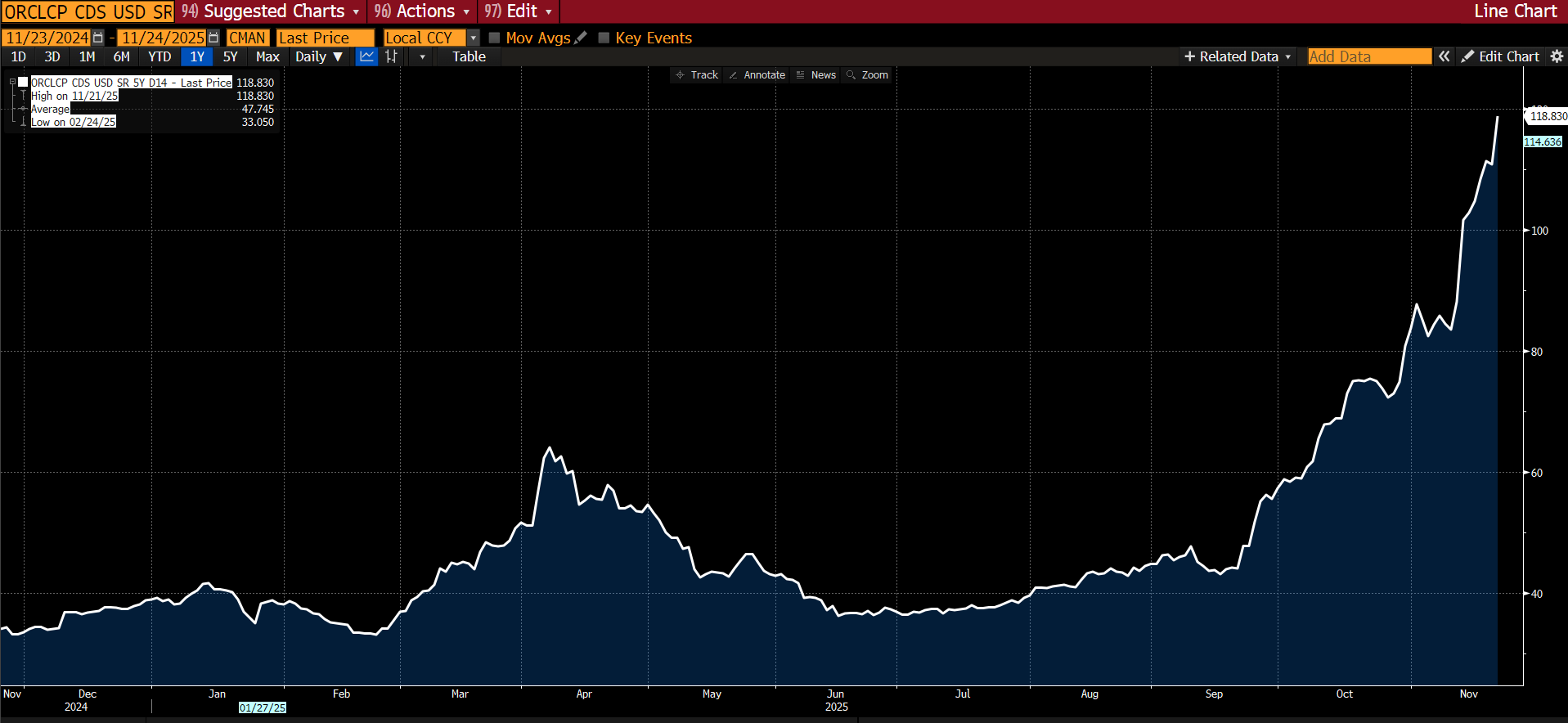
We’re going to largely skip markets again, because the sweater is rapidly unraveling in other areas as I pull on threads. Suffice it to say that the market is LARGELY unfolding as I had expected — credit stress is rising, particularly in the tech sector. Many are now pointing to the rising CDS for Oracle as the deterioration in “AI” balance sheets accelerates. CDS was also JUST introduced for META — it traded at 56, slightly worse than the aggregate IG CDS at 54.5 (itself up from 46 since I began discussing this topic):
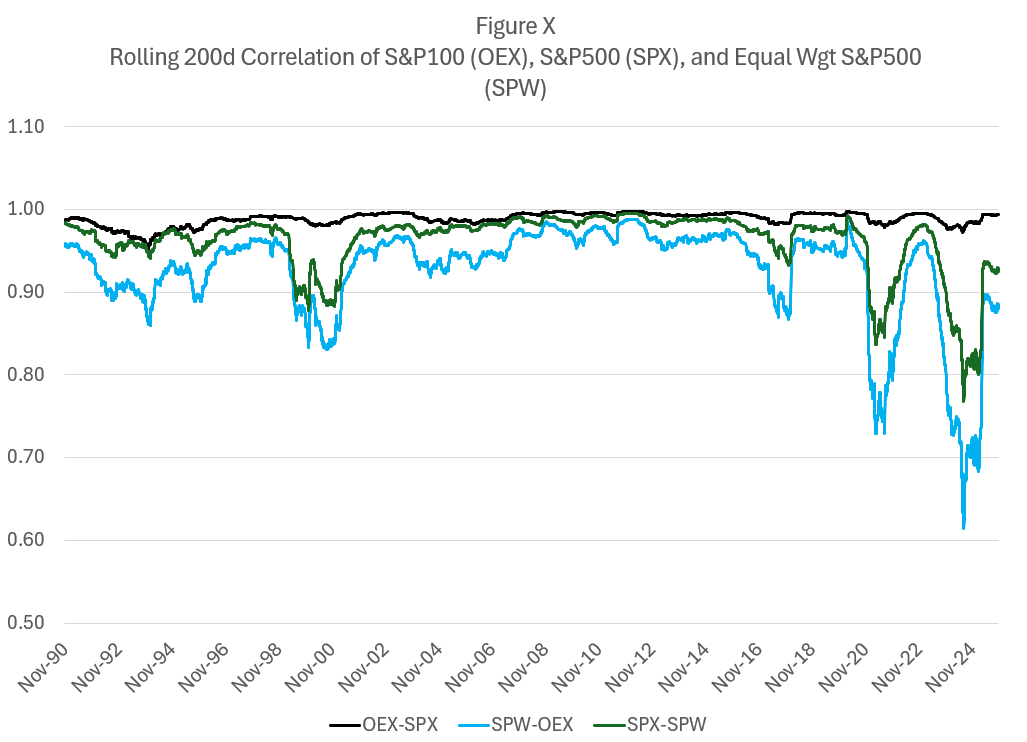
Correlations are spiking as MOST stocks move in the same direction each day even as megacap tech continues to define the market aggregates:
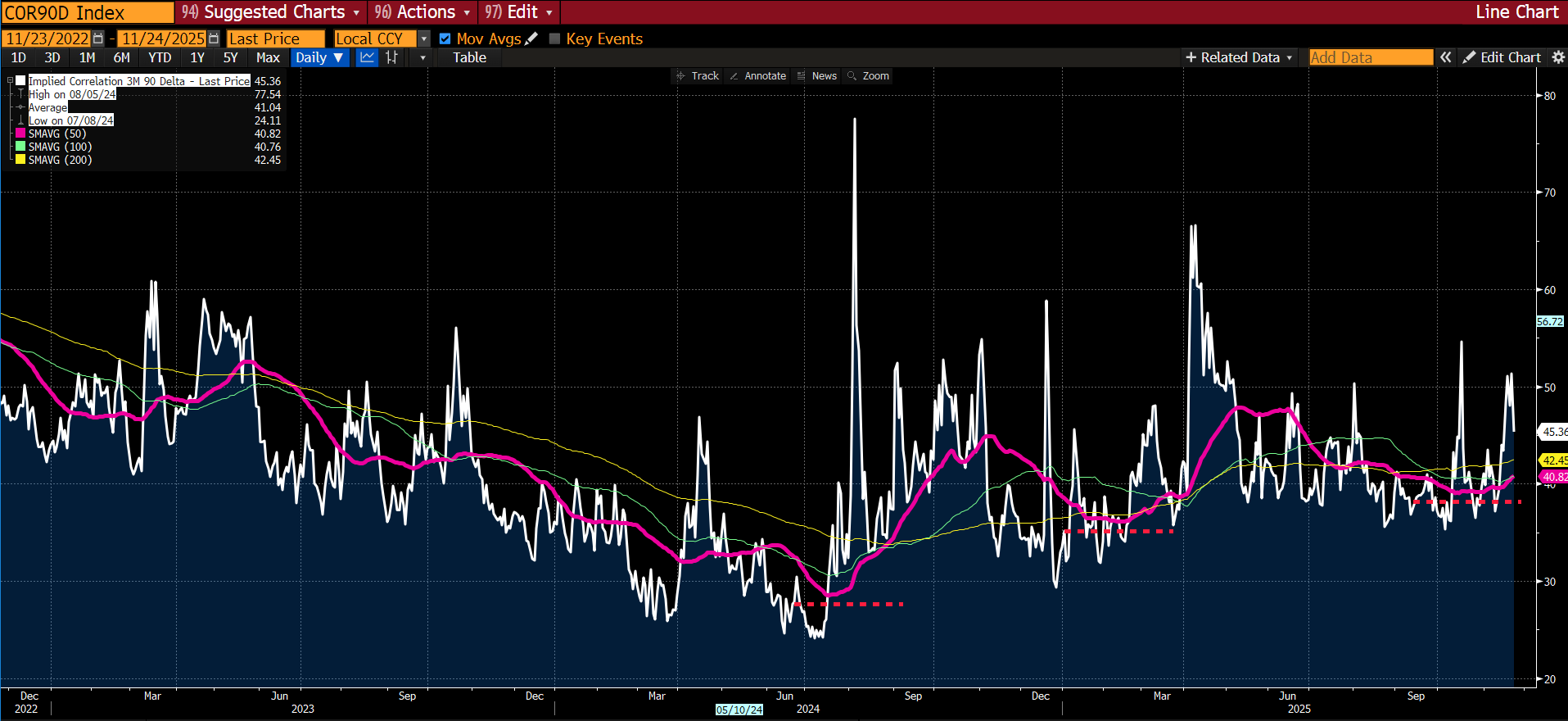
Market pricing of correlation is beginning to pick up… remember this is the “real” fear index and the moving averages are trending upwards:
And, as I predicted, inflation concerns, notably absent from any market-based indication, are again freezing the Fed. The pilots are frozen, understanding that they are in Zugzwang — every choice has unfavorable options.

And so now, let’s tug on that loose thread… I’m sure many of my left-leaning readers will say, “This is obvious, we have been talking about it for YEARS!” Yes, many of you have; but you were using language of emotion (“Pay a living wage!”) rather than showing the math. My bad for not paying closer attention; your bad for not showing your work or coming up with workable solutions. Let’s rectify it rather than cast blame.
How a Broken Benchmark Quietly Broke America
I have spent my career distrusting the obvious.
Markets, liquidity, factor models—none of these ever felt self-evident to me. Markets are mechanisms of price clearing. Mechanisms have parameters. Parameters distort outcomes. This is the lens through which I learned to see everything: find the parameter, find the distortion, find the opportunity.
But there was one number I had somehow never interrogated. One number that I simply accepted, the way a child accepts gravity.
The poverty line.
I don’t know why. It seemed apolitical, an actuarial fact calculated by serious people in government offices. A line someone else drew decades ago that we use to define who is “poor,” who is “middle class,” and who deserves help. It was infrastructure—invisible, unquestioned, foundational.
This week, while trying to understand why the American middle class feels poorer each year despite healthy GDP growth and low unemployment, I came across a sentence buried in a research paper:
“The U.S. poverty line is calculated as three times the cost of a minimum food diet in 1963, adjusted for inflation.”
I read it again. Three times the minimum food budget.
I felt sick.
Analysis continues at the link.
– 30 –
tl;dr – he argues that a 1963 life style had structural and social components (providing housing, health care and child care) that make the current 31k USD equivalent poverty line actually 140-160k for a ‘middle-class family of four’, and that’s just in rural or suburban Normiestan, not freakish places like SF or NYC or Seattle.
The article does not discuss why the institutional destruction of 1963 culture occurred (a communist revolution in 1968 that resulted in the ’emancipation’ of women, combined with Fed-induced inflation)
Leave a Reply