Reprint of https://thephora.net/phoranova/index.php?threads/the-real-problem-with-spain-and-portugals-electrical-grid.2002/ (Monday, 4/28/2025) at the Phora, a private forum, to make thread from the ‘Electricools’ subforum public:
… in Electricool terms: There is ‘Grid Inertia’ and ‘Grid Frequency’ and sudden drops in power capacity (‘rare atmospheric conditions’) can cause a grid frequency instability
https://www.renewableenergyworld.com/solar/grid-inertia-why-it-matters-in-a-renewable-world/ (2019 so a well known issue with having renewables on grid, and one surely planned for — perhaps not competently in Iberia’s case)
Here is how Texas and ERCOT grid (one of three major grids in the US) handles this issue, per the Department of Energy’s NREL unit:
https://www.nrel.gov/docs/fy20osti/73856.pdf (2020 paper)
News accounts:
6 Days After Celebrating ‘100% Renewable Power’, Spain Blames “Rare Atmospheric Phenomenon” For Nation’s Largest Blackout In History | ZeroHedge
ZeroHedge – On a long enough timeline, the survival rate for everyone drops to zero
www.zerohedge.com
Thread related

https://thephora.net/phoranova/index.php?threads/your-power-grid-and-net-woes-2025.1902
Needless to say, the political spin will be ‘global warming caused this condition so we need more green power’ — which will drive the grid further towards instability in this particular mode, by lowering the grid inertia further.
Tuesday 4/29/2025:
Looks like they need to redo this exercise from 2016 with a new crew… that was a decade ago nearly, gents. Probably some personnel turnover since then…
Starting off from a serious incident which occurs at 9:00am, which causes a mock widespread zero voltage condition that affects the entire peninsular electricity system and with a potential impact on the southwest of France. As of that moment, Red Eléctrica de España, with the collaboration of REN and RTE, activates the general process for the restoration of the electricity supply based on “electrical islands” created around those generating units with black start capability.
In particular, the simulation consists of the task of restoring power in the following zones: Aragon-Catalonia, Galicia-León, Asturias-Cantabria, the Duero-France axis as well as the northern zone of the Portuguese system and the southern part of the French system. In addition, the communication protocol with the security forces and bodies, both State and those of the autonomous regions, is activated. This protocol is signed by the State Department for Security with the large national electricity operators.
After the initial creation of these “islands” and with the coordinated support of international interconnections, including the new direct current link between Santa Llogaia (Spain) and Baixas (France), the supply to nuclear power stations is secured and the ancillary services of the first combined-cycle generating units are activated. At 1:00pm the drill is considered finalised after having brought the system back online in a safe operating state, with all the implicated zones synchronized and reaching a high level of supply of consumption.
The robustness and reliability of the Spanish electricity system, in which few incidents occur, limit the possibilities of operators gaining experience in handling especially complicated situations. For this reason, Red Eléctrica performs simulations, in order to improve the processes, the coordination of all the entities involved at both national and international level, and to reduce, as far as possible, the time necessary to restore the system.
Here’s how that plan was looking as of last night… I guess they start with the edges and work in, which makes sense because you want your ports and coastal defences working early on…
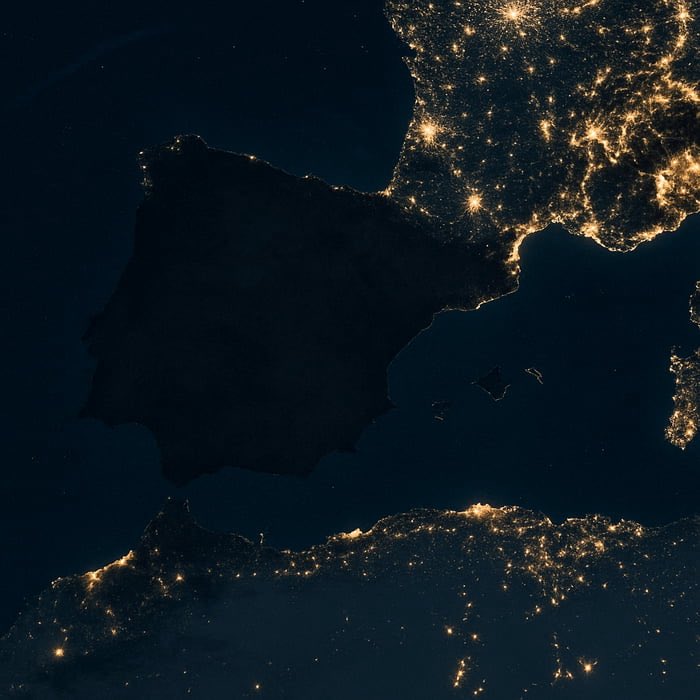
Image source:
A true travesty of Journalism:
And wait for it…
[URL unfurl=”true”]https://www.msn.com/en-us/weather/topstories/did-induced-atmospheric-vibration-cause-blackouts-in-europe-an-electrical-engineer-explains-the-phenomenon/ar-AA1DQZpF[/URL]
As The Guardian initially reported Portugal’s REN as saying:
Did ‘induced atmospheric vibration’ cause blackouts in Europe? An electrical engineer explains the phenomenon
“Due to extreme temperature variations in the interior of Spain, there were anomalous oscillations in the very high voltage lines (400 kV), a phenomenon known as “induced atmospheric vibration.” These oscillations caused synchronization failures between the electrical systems, leading to successive disturbances across the interconnected European network.”
In fact, “induced atmospheric vibration” is not a commonly used term, but it seems likely the explanation was intended to refer to physical processes climate scientists have known about for quite some time.
In simple terms, it seems to refer to wavelike movements or oscillations in the atmosphere, caused by sudden changes in temperature or pressure. These can be triggered by extreme heating, large-scale energy releases (such as explosions or bushfires), or intense weather events.
When a part of Earth’s surface heats up very quickly—due to a heat wave, for example—the air above it warms, expands and becomes lighter. That rising warm air creates a pressure imbalance with the surrounding cooler, denser air. The atmosphere responds to this imbalance by generating waves, not unlike ripples spreading across a pond.
These pressure waves can travel through the atmosphere. In some cases, they can interact with power infrastructure—particularly long-distance, high-voltage transmission lines.
These types of atmospheric waves are usually called gravity waves, thermal oscillations or acoustic-gravity waves. While the phrase “induced atmospheric vibration” is not formally established in meteorology, it seems to describe this same family of phenomena.
What’s important is that it’s not just high temperatures alone that causes these effects—it’s how quickly and unevenly the temperature changes across a region. That’s what sets the atmosphere into motion and can cause power lines to vibrate. Again, though, it’s still unclear if this is what was behind the recent blackout in Europe.
More centralized, more vulnerable
Understanding how the atmosphere behaves under these conditions is becoming increasingly important. As our energy systems become more interconnected and more dependent on long-distance transmission, even relatively subtle atmospheric disturbances can have outsized impacts. What might once have seemed like a fringe effect is now a growing factor in grid resilience.
Under growing environmental and electrical stress, centralized energy networks are dangerously vulnerable. The increasing electrification of buildings, the rapid uptake of electric vehicles, and the integration of intermittent renewable energy sources have placed unprecedented pressure on traditional grids that were never designed for this level of complexity, dynamism or centralization.
Continuing to rely on centralized grid structures without fundamentally rethinking resilience puts entire regions at risk—not just from technical faults, but from environmental volatility.
The way to avoid such catastrophic risks is clear: we must embrace innovative solutions such as community microgrids. These are decentralized, flexible and resilient energy networks that can operate independently when needed.
Strengthening local energy autonomy is key to building a secure, affordable and future-ready electricity system.
The European blackout, regardless of its immediate cause, demonstrates that our electrical grids have become dangerously sensitive. Failure to address these structural weaknesses will have consequences far worse than those experienced during the COVID pandemic.
This article is republished from The Conversation under a Creative Commons license. Read the original article.
Provided by The Conversation
– 30 –
Me:
If that’s the best the media can do … wow. I rate that at a zero information article. It has some ‘scientific references’ but they do not explain how the atmosphere (and implicitly climate) has anything to do with oscillations in a 400 kV line. The reference to ‘climate’ is to a standard text on oscillations in climate like ENSO (El Nino/La Nina) and similar things, not even related to the topic of the article except both are about wave phenomena, one in the climate, the ‘grid inertia’ problem in an electrical grid. There is a picture at the top of ‘wave clouds’ which are indeed examples of ‘gravity waves’, but nothing to indicate how that affected the transmission lines or even a claim that the phenomenon was observed that day.
It throws in a Hail Mary ‘AI can save us with microgrids and renewables’ at the end: https://www.mdpi.com/2071-1050/16/12/4959
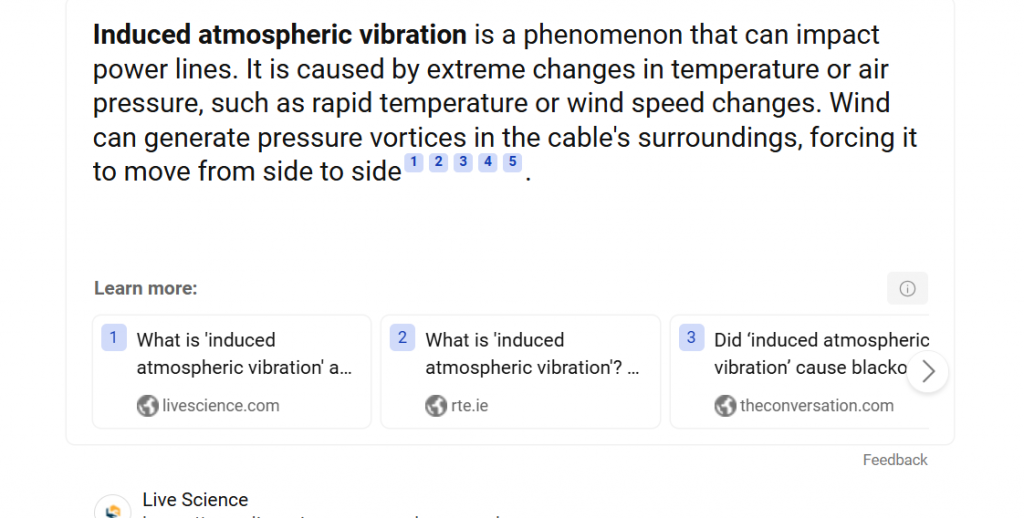
Continuing to review this topic… AI generated summary by Bing Co-Pilot[1] cites 5 sources, the first 4 of which are bullshit or misunderstandings, but one of which may actually be worth reading:
[5]:
Excerpts:
The term atmospherically induced vibration describes a physical phenomenon that primarily affects high and very high voltage transmission lines. It consists of the appearance of oscillatory movements in electrical conductors (the elevated cables we see on large towers), generated by the interaction between electrical factors and external atmospheric conditions.
The process begins when certain meteorological circumstances occur, such as sustained wind, sudden changes in temperature, or high humidity. This can lead to the appearance of what is known in electrical engineering as corona discharge, which ionizes the air around the conductor and produces small currents between the metal and the atmosphere.
The charged particles thus generated interact with the intense electric field of the high voltage lines, which gives rise to periodic electrohydrodynamic (EHD) forces. These forces are not mechanical in the strict sense, but rather the result of the interaction between electricity and the atmosphere.
Due, Pressure waves are generated in the surrounding air that directly affect the cable itself.When the frequency of these alternating forces approaches or coincides with the natural vibration frequency of the conductor, the phenomenon of resonance occurs.
This resonant state can greatly amplify the oscillations of the cable., causing vibrations of considerable amplitude even though wind or temperature conditions appear to be normal to the naked eye.
How do wind and extreme temperatures affect this phenomenon?
Induced atmospheric vibration is especially likely when two elements come together: constant wind (without sudden gusts or intense turbulence) and unusual temperatures (both high and very low).
Wind can generate pressure vortices in the cable’s surroundings, forcing it to move from side to side. If the speed of these vortices matches the cable’s natural vibration frequency (which depends on its length, mass, and tension), intense vibrations can occur.
Extreme temperatures alter the mechanical behavior of conductors.Heat causes cables to expand and become looser, while cold causes them to contract and tighten. Both effects influence their resonant frequency, making them, in many cases, more vulnerable to wind-induced vibrations.
Added to this is the corona discharge in situations of high humidity or presence of suspended particles., which facilitates the production of the aforementioned EHD forces.
Differences with other types of vibrations in power lines
In the world of electrical engineering, high-voltage overhead lines can experience vibrations of a wide variety of types and origins. It is essential to distinguish induced atmospheric vibration from other similar phenomena that are commonly studied.
- Classical wind vibration: It produces intermediate-frequency oscillations due to the passage of wind. It is usually more predictable and especially affects longer, lower-voltage conductors.
- Gallop: A phenomenon caused by the accumulation of ice or snow on the cable, accompanied by wind. It results in high-amplitude, low-frequency vibrations.
- Induced atmospheric vibration: It is characterized by oscillating at frequencies between 0,1 and 10 Hz, and its main trigger is the combination of particular electrical conditions and atmospheric factors, not just wind.
This difference in origin and mechanism is key to understanding why induced atmospheric vibration is so difficult to predict and mitigate..
Direct and indirect consequences on the electrical system
The repercussions of induced atmospheric vibration can be very varied and depend on both the intensity and duration of the phenomenon. Although in many cases their effects are limited to audible noises or slight cable displacements, under extreme conditions they can cause real, large-scale problems.
In the long term, repeated exposure to vibrations – even of low amplitude – causes fatigue in materials. which make up the conductors, the insulators and also the hardware that keeps the entire system standing.
This translates into a higher probability of the appearance of cracks, loose connections and accelerated wear at contact points between different elements.
In some cases of especially intense atmospheric vibrations, automatic protection systems can interpret that there is a serious anomaly and proceed to disconnect entire lines to avoid further damage.
Furthermore, if the vibration alters the synchronization of interconnected electrical systems, a chain reaction of cascading disconnections or outages can be triggered, as occurred in the great blackout of April 2025, with the failure spreading beyond the initial point.
Why has the official explanation been so controversial?
The attribution of the April 2025 blackout to induced atmospheric vibration has not been without controversy. From the outset, experts in physics, meteorology, and electrical grids have expressed caution regarding the possibility of such a rare phenomenon having such a devastating effect.
Some scientists, such as physicist Mario Picazo, stressed that considerable wind or extreme thermal changes would be necessary to trigger resonances in the power grid of the magnitude observed. Although there were significant temperature amplitudes (nearly freezing nights followed by highs of 20-25°C), most consider it unlikely that this factor alone was enough to cause the collapse.
Other experts, such as José María Madiedo, an astrophysicist at the Institute of Astrophysics of Andalusia, have gone further, ruling out that induced atmospheric vibration, triggered by some rare atmospheric phenomenon, is a sufficient explanation.Madiedo proposed the possible impact of a solar event (Carrington type) as an alternative, although the lack of recent solar storms or simultaneous global impact ruled out this hypothesis.
Network operators and authorities, meanwhile, have remained cautious.Although they have acknowledged the complexity and exceptional nature of the incident, they insist that there is still no conclusive evidence regarding the exact cause. The investigation remains ongoing, and transparency has been key to avoiding hoaxes and speculation.
The recovery process and associated difficulties
Restoring power after the blackout of April 28, 2025, has been neither simple nor immediate.The main complication is that, as this is an internationally interconnected network (Spain, Portugal, France, and Morocco), any recovery attempt must be gradual and extremely coordinated.
The procedure followed has consisted of progressively activating the key generators of each country to align electricity production with users’ actual consumption. This “gradual reconnection” is essential to avoid further overloads or desynchronizations that could disrupt the restoration process.
France, for example, has collaborated by supplying energy to the Spanish system through the northern border.At the same time, Portugal has proceeded to disconnect its grid from the Spanish grid to restore normality using its own resources and avoid a further domino effect.
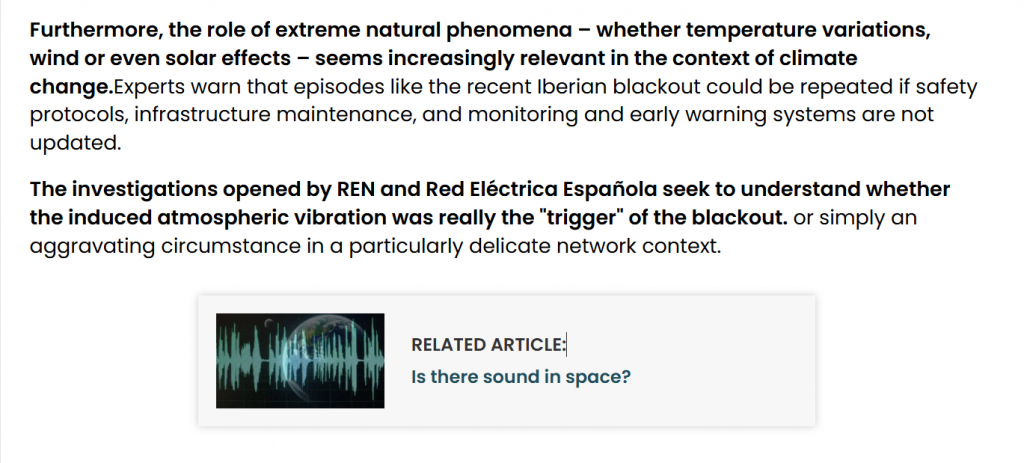
In this stage, the study of sound in space and how vibrations can affect different systems is relevant to understanding the possible causes of the blackout.
In this stage, Resilience and coordination between operators and governments play a fundamental role to restore stability to the European energy system after an extreme event.
Lessons learned and new challenges for the future
The incident has highlighted several vulnerabilities inherent in current power grids.The pursuit of maximum efficiency through the interconnection of multiple countries and systems has complicated crisis management and recovery from serious incidents.
Furthermore, the role of extreme natural phenomena – whether temperature variations, wind or even solar effects – seems increasingly relevant in the context of climate change.Experts warn that episodes like the recent Iberian blackout could be repeated if safety protocols, infrastructure maintenance, and monitoring and early warning systems are not updated.
The investigations opened by REN and Red Eléctrica Española seek to understand whether the induced atmospheric vibration was really the “trigger” of the blackout. or simply an aggravating circumstance in a particularly delicate network context.
– 30 –
[1] Bing Bing Bing Ricochet Co-Pilot hallucinates:
My analysis (so far)
tl;dr — looks like the physicists are giving the ‘induced atmospheric vibration’ explanation a thumbs down. I will follow up, if I can the hints in the above article and see if I think there is anything to the EHD (electrohydrodynamic) theory.
Most of the media coverage is ‘not even wrong’ because it fails to say what the magical theory that no one ever heard of before last Monday, even is, much less cite articles or actual persons who can witness or provide expert testimony on the topic.
The actual mechanism of the grid collapse seems uncontroversial — there was an instantaneous or at least sudden drop in demand (the cause of which is disputed) that was outside the stability envelope for the network, following a problem with a particular and known 400 kV transmission line, and it initiated the usual cascade of collapses, extending to all of Spain of Portugal, and part of France, necessitating a black start that took 12 hours to accomplish. It is possible that the lack of ‘synchronized inertial’ (code for rotating steam generators rather than power inverters, aka fossil fuels and nuclear) narrowed the operational window. It is well known that renewables affect the grid this way, no one contests it, and like running with scissors everyone does it anyway and nothing bad happens until it does.
Also, it has little if anything to do with actual physical AGW and/or gravity waves (which are common in mountainous areas such as where I live in the Olympic Peninsula), and are in any event a common, everyday occurrence that Meteorologists, Climatologists, and anyone who knows Fluid Mechanics like Physicists, knows all about.
The problematic part of the analysis is to go from the observed symptom (the sudden demand drop in a single 400 kV powerline) to understand a plausible sequence of events that caused it. Renewables didn’t cause that spike, and neither did AGW, and probably not Russia either. The fragility and implications for grid operation have been been known and debated for years.
This is specific, and specifically *not* wind (only) related, nor ‘Gallop’
- Induced atmospheric vibration: It is characterized by oscillating at frequencies between 0[.]1 and 10 Hz, and its main trigger is the combination of particular electrical conditions and atmospheric factors, not just wind.
Most of the web-based information on this topic (EHD, corona discharges, and resonant weather effects on transmission characteristics) is going to be in discussions about the environmental impacts of having transmission lines near you. Here are some leads — notice that ‘corona discharge’ can ionize shit, and the winds cause the effect are WINDS OF IONS (like an EMP effect btw)
[1]: [NRC: Package ML120900041 -Withdrawal of RG 7.3, Procedures for Picking-Up and Receiving Packages of Radioactive Material](https://www.nrc.gov/docs/ML1209/ML120900041.html)
Mentions meteorological conditions and transmission lines in this exhibit: https://www.nrc.gov/docs/ML1209/ML12090A853.pdf
> The other types of sounds that are caused by transmission lines are sizzles, crackles, or hissing noises that occur during periods of high humidity. These are usually associated with high-voltage transmission lines and are very weather dependent. They are caused by the ionization of electricity in the moist air near the wires. Though this noise is audible to those very close to the transmission lines, it quickly dissipates with distance and is easily drowned out by typical background noises. Ionization in foggy conditions can also cause a corona, which is a luminous blue discharge of light usually where the wires connect to the insulators. [italics mine]
[2]: [Environmental Impact Analysis of Electric Power Lines | IEEE Conference Publication | IEEE Xplore](https://ieeexplore.ieee.org/document/8494536)
(abstract only)
[3]: [EMF and Living Near High-Voltage Lines | Thomas Edison Electric](https://thomasedisonelectric.com/tips/safety/emf-and-living-near-high-voltage-lines)
(no relevant information)
[4]:[Fact sheet explores common health concerns related to power lines | Center For Rural Affairs – Building a Better Rural Future](https://www.cfra.org/news-release/fact-sheet-explores-common-health-concerns-related-power-lines)
[5]: [Numerical Investigation of Ionic Wind-Flow Characteristics in Direct-Current Transmission Conductors With Different Cross- Sectional Geometries | IEEE Journals & Magazine | IEEE Xplore](https://ieeexplore.ieee.org/document/10832515)
This last one discusses the effect for the case of DC transmission, so it is only indirectly relevant, but informative as to what the effect alluded too, which none of the pols or journalists understand, but probably is a real ‘thing’, though maybe a real but irrelevant thing:
>
Abstract:
Corona effect is a critical factor in the design and construction of ultrahigh-voltage (UHV) transmission lines, since it can cause ionic wind, which induces destructive instability, such as conductor vibration and rotation. Here, we develop a 2-D unipolar ion discharge model by using electrohydrodynamic (EHD) methods coupled with Navier-Stokes (N-S) equations. The effects of conductor cross-sectional geometry and voltage levels on the distribution of electric field, characteristics of ionic wind, and distribution of EHD force during the corona discharge have been studied. It is shown that both the cross-sectional geometry and voltage level have significant influence on the aerodynamic characteristics of the conductor. A higher corona inception field strength can be produced when the conductor geometry is closer to a cylindrical shape. As the number of strands in the conductor is increased, the cross-sectional geometries become more complex, leading to greater electric field distortion, which assists the ionic wind effect and maximum composite velocity. Higher voltage levels inhibit the ionic wind speed, resulting in a reduced maximum composite velocity. Moreover, the increases in the number of conductor strands and voltage levels can enhance the EHD force, inducing the fluctuations in ionic wind velocity around the conductors. Our results provide insights into ionic wind generation from corona discharges in transmission lines and offer theoretical guidance for mitigating the corona-induced vibrations.
[6]: Here’s a similar analysis and you can read more than just the abstract — it has to do with wire-plate ionizers which are part of electrostatic precipitators (used to ‘scrub’ exhaust fumes in some industrial ‘smoke stacks’)
https://www.cambridge.org/core/journals/journal-of-fluid-mechanics/article/numerical-analyses-of-wireplate-electrohydrodynamic-flows/CAE5923F215F6BBCDAA806058906D88E
[7]: https://pubs.aip.org/aip/pop/articl…lytical-model-of-electro-hydrodynamic-flow-in
So the gist of things here is ‘corona discharge can ionize air, and flowing air can interact with EHD media to create vortices…’
[8]: https://www.sae.org/publications/technical-papers/content/2024-01-7010/ (getting closer?)
Study on the Electrohydrodynamic Performance of a Multiple Wire-Cylinder Ionic Wind Generation System 2024-01-7010
getting closer? It’s abstract only but we can find a similar paper
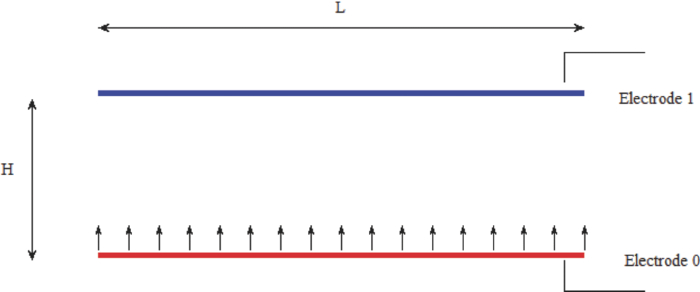
Two-dimensional numerical analysis of electroconvection in a dielectric liquid subjected to strong unipolar injection
Two-dimensional numerical simulations are carried out to examine the problem of transient electroconvection stability of dielectric liquids subjected to unipola
pubs.aip.org
NOW I want to know if the failed transmission line was HVDC (and so did not need synchronization) or a ‘normal’ 400kV transmission line, in which case it is AC.
summarizing then, so far:
1. a 400kV [1] transmission line was disconnected from the European grid, between French and Spanish Catalonia.
> On Monday 28 April, between 12:38 and 13:30 CET, Spain’s transmission system was disconnected from the European grid at the 400 kV level due to an issue with a power line connecting French and Spanish Catalonia. The fault triggered a domino disrupting electricity supply not only in Spain but also in Portugal, Andorra, and parts of France.
[1]: https://www.eurelectric.org/news/what-you-need-to-know-about-the-iberian-peninsulas-blackout/
2. The proposed theory involves the known effects of corona discharge and the induced ‘ion wind’ being forming in an unusual way that relates to meteorological conditions (not uncommon with transmission lines) that affected the ‘failed’ transmission line system.
3. The physics setup for such an effect involves solving a coupled EHD / Navier-Stokes problem, and I have not yet found a plausible model. References 6-8 above give related examples.
Townsend Discharge theory (1914) is well known: https://en.wikipedia.org/wiki/Townsend_discharge
4. Similar studies simulating HVDC (DC not AC) transmission lines show an effect that ‘resonates’ and creates vortices.
5. The physical theory or exact explanations of why it applies to this place and situation is not yet provided.
6. The use of renewables rendered the operation of the interconnect fragile. Hydroelectric power was the ‘grid inertia’ (rotating steam generators) used for the black start.
Source: https://x.com/energybants/status/1917207268191359284
SPAIN BLACKOUTS: AN ANONYMOUS EXPERT VIEW
From a deep groupchat, last night, translated from Spanish, written by an expert in transmission and distribution of power. Not my words.
“What has happened on April 28 has a well-located origin: the Aragón-Catalonia corridor, which is one of the most important electric highways in Spain. There is not only the electricity produced by our solar and wind farms in the northeast, but also the electricity that we import from France. This international interconnection, although weak (it can only contribute 3% of our demand, well below the minimum of 10% that marks the EU), in times of stress is essential to balance the network.
At 12:32 p.m., in that Aragón-Catalonia corridor there was an electric shock. What exactly does “shake” mean? It means that suddenly and abnormally, the power that flowed through those lines began to vary violently, rising and falling in a very short time. Such abrupt variability can be due to three main causes:
1. That a relay or transformer on that electric highway detects an abnormal flow of current or voltage (higher or lower than expected) and automatically disconnected to avoid burning or destroyed. This is called that “opens” a relay or switch: it jumps and cuts the passage of electricity to protect itself.
2. That the enormous concentration of renewable energy in that area (mainly solar and wind) has created an electrical resonance: electronic inverters, which synchronize current, can sometimes be amplified between them if a small voltage alteration (for example, due to clouds, strong wind or a slight failure) extends like an echo to all devices, causing widespread oscillations.
3. That a wrong control order has been sent (by mistake or attack) from the SCADA systems, disconnecting or reducing the generation of multiple hit plants. There is no confirmation of this possibility yet, but it is being investigated.
What is known is that as a consequence of that shake, the interconnection with France jumped: we were isolated just at the worst time, when the peninsula needed external support to stabilize.
Without that French help, the frequency of the peninsular network (which should always be 50 Hz exact) began to drop quickly. The frequency is like the heartbeat of the network: if it falls too much, the systems understand that the patient (the network) is collapsing and automatically disconnected so as not to self-destruct. Thus, in just five seconds, the solar and wind farms were turned off —very sensitive to frequency variations—, 15 GW of power was lost suddenly (60% of all the electricity generated at that time), and the network could not take it anymore: it was It collapsed completely, showing the Redeia Platform (REE) a “0 MW” nationwide. That does not mean that all the turbines were physically turned off, but there was no generator synchronized at the common frequency of 50 Hz. It was, for practical purposes, a country off.
To ignite a completely dead network again, one essential thing is needed: plants that can start in black, that is, without receiving energy from anywhere else. Spain has identified five large hydroelectric jumps capable of doing this. However, and here is one of the great negligences that are coming to light, three of those five groups were stopped in scheduled maintenance, by business decision supervised by the administration. Only two were operational. That made the recovery much slower and weaker than it should be in a normal contingency plan.
The result is that, after almost 10 hours, only 35% to 40% of the national supply has been recovered, and there are still large areas in the dark or under scheduled cuts.
The situation reveals a very serious underlying problem:
Spain is still an energy island: it only has 3% foreign exchange capacity compared to its total demand.”… Cont:
Part 2: “The network depends a lot on variable renewables, which are disconnected quickly in the face of any instability.
The lack of physical inertia reserves (i.e. large rotating masses such as thermal power plants or classic hydraulics) prevents the disturbances from damping.
And poor maintenance planning left without enough hydraulic muscle to respond to a crisis. The most likely causes, with current data, are:
A combination of technical failure in protection or in synchronization, added to a serious lack of operational forecast and maintenance (probability ≈ 40%).
The possibility of an intentional cyber-physical attack remains in analysis (≈ 25% estimated probability).
Other factors such as human error, punctual atmospheric phenomenon or mixed causes complete the rest.
In short: an initial shake at the most sensitive point of the Spanish network —the Aragón-Catalonia corridor, door to Europe— left the peninsula isolated and vulnerable. The network could not sustain its own demand because it did not have sufficient assistance, nor stable physical reserve, nor enough bootable plants in black. Three of five hydroelectric jumps were out of service when they were most needed.
For this reason, Spain went out in five seconds, and that is why it still continues to light little by little, fragile, slow and exposed.”
– 30 –
Wed (4/30/2025):
My continuing research into ‘atmospherically induced vibration’ that isn’t gallop:
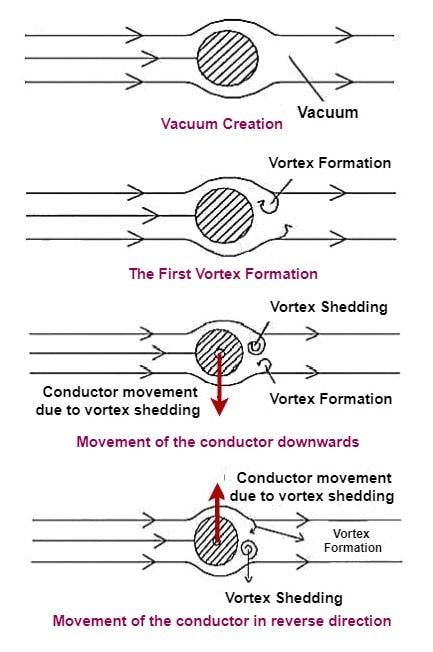
Aeolian Vibration Of Transmission Conductors
Aeolian vibration is a type of motion caused by wind on conductors and overhead shield wires of transmission and distribution lines. Aeolian vibration is
 studyelectrical.com
There is some old terminology in play here, and some etymology for enthusiasts like @Mike
Aeoline and Aeolina are both words. Both derive from Aeola (a kind of harp from antiquity), with the latter coming via German and the English coinage due to Sir Charles Whetstone, the physicist who invented famously the Whetstone bridge, but also invented musical instruments, such as the aeolina (a sort of harmonica), and the concertina.
With that etymological background, it is easy to understand the sort of ‘atmospheric conditions’ that might result in transmission line vibrations leading to failure. Transmission lines need to have certain oscillatory modes properly damped.
However, the explanation proffered in our key explanatory source [5] above, specifically mentions a role for EHD coupled to atmospheric conditions, so I don’t think we’re quite there yet.

Leave a Reply to Macrobius Cancel reply