Review of Dugin’s Fourth Political Theory trilogy | TBC
This thread will (eventually) review all three volumes of Dugin’s 4PT trilogy
– The Fourth Political Theory (v. 1, 2009)
– The Rise of the Fourth Political Theory (v. 2, 2017)
– Politica Aeterna: Political Platonism (v. 3, 2024)
His current work on Trumpism (_The Trump Revolution: A New Order of Great Powers _), and the emerging Multipolar World Order, is very much in progress as are the events defining it. It is thus more collections of recent articles, often of different vintage, than a mature, considered work of political theory.
I will start _in medias res_ with v. 2, because it is both recent and sets up the latest work — and together these works have not been as extensively reviewed and disussed as the 16 year old original publication in the series. At that point, we will be able to come back and review the work.
Here, to get us started, is a comparative chart of the four political theories — the first three are liberalism, Communism, and fascism, with the last including related ideologies as Mussolini or Peronism.
[images at the TBC and Phora thread go here]
Some preliminary comments on the schema above. Dugin is often portrayed by various packs of braying-dog liberals, as some sort of fascist. He very clearly delineates his position, with Guenon and Evola, as a Traditionalist evolving his 4PT, from the 3PT of fascism, point by point. There are indeed points of agreement — but also differences and nuances, such as we saw with Evola vis-a-vis both Mussolini and National Socialism.
Another point of analysis in the above is .Dugin’s schema of pre-Modern, Modernity, Romanticism as a false return to the ‘pre-M’, and post-modernity/post-liberalism. By ‘Romanticism’ what is substantially meant is what in Spenglerian contexts would be called Faustian culture and its development into its ‘peak form’, as a Faustian civilisation, as formulated since Goethe. This was adequately assessed by Greer from numerous perspectives (Spenglerian, Neo-Platonic, Western Esoteric Tradition) in his work on Wagner[1][2].
[I will cite TBC versions of threads, so far as I can, since they are public but the Phora analogues can be found by searching]
[2]: https://www.ecosophia.net/tag/richard-wagner/
Dugin’s observations sharpen Greer’s exposition of the way in which Wagner combines both ‘Libertarian Socialism’ (the Anarchism of Wagner’s friend Bakunin), a blend of 1PT and 2PT, and the latent and later developed 3PT, ‘National Socialism’ in the Romantic Matrix. Greer, who is at heart a Neo-Platonist but not a Traditionalist, though he knows of the Guenonians and accounts for them in his _King in Orange_ work[3][4], plays down the importance of the Romantic influence on the development of National Socialism and similar forms of ideology related to fascism and the the possibility of some role for Romanticism/Faustian of Spengler’s Ethical Socialism (Dugin also has works on Ethos/Ethnos and the Social order).
[3]: https://thephora.net/phoranova/index.php?threads/greer-on-wagner-and-the-after-times-we-live-in.1907
[4]: https://thephora.net/phoranova/index.php?threads/john-michael-greer-the-king-in-orange-trump.1676/
Two final point of analysis are the mention of Neo-Platonism and 2/ ‘the paideia for the nation’ as an educational idea.
Before discussing these, I must note a tendency in Traditional Catholic, i.e. Western Christians, circles, to turn Aristotle vs. Plato into a dichotomy that amounts to Aristotle, Aquinas, and the Latin West on the one hand, in opposition to ‘Platonism’ and all forms of ‘esotericism’ (conceived of as occultism, magick, and alchemy mostly) as the enemy. In writers such as Stephen Coughlin (who via Rich Higgins had some influence on the first Trump administration, until the post-Charlottesville McMaster of summer 2017, which also hobbled Bannon), this turns into a misreading of even Catholic sources, and a bizarre proposal that Aquinas be purged of ‘mistaken Platonic influences that scholars have since debunked’, as the ‘pseudo’-Dionysios! Needless to say, such proposals go far beyond anything Barlaam would have proposed, much less St Gregory Palamas!
Both Sherrard and Dugin, despite their different takes on Guenon, are Traditionalists (as am I). Sherrard and I would reject Guenon at least in parts[5], while supporting some form of Traditionalism, conceived as Dugin conceives it as anti-Modernity. In the context of the Western, Catholic and post-Orthodox culture of the last millennium, this means the opposition of the via moderna (Modernity) to the via antiqua, in Philosophy.
[5]: for Sherrard, this was explicit in _Christianity: Lineaments of a Sacred Tradition_.
Dugin, in his third volume, will restore both Platonism and Aristotelianism in an Orthodox Christian and Traditionalist perspective. Sherrard’s reading of St Gregory Palamas, and the Byzantine tradition, may be defective, though his support for philokalia vs philosophia (given that he is the primary English translator of the Philokalia!) is certainly defensible. Comparing Sherrard and Dugin along the way my help define the *internal* debate over philosophy that Orthodox Christians have been having since at least the time of Origen, and that we desperately need to complete today.
At stake is the question, what use may Orthodox Christians make of Modernity and Modern Science — that is, participate in our doomed technological, post-capitalist/post-liberal civilisation, either West or East. Both Sherrard and Dugin offer the Traditionalists choice of radical rejection of the World, certainly of the Modern World.
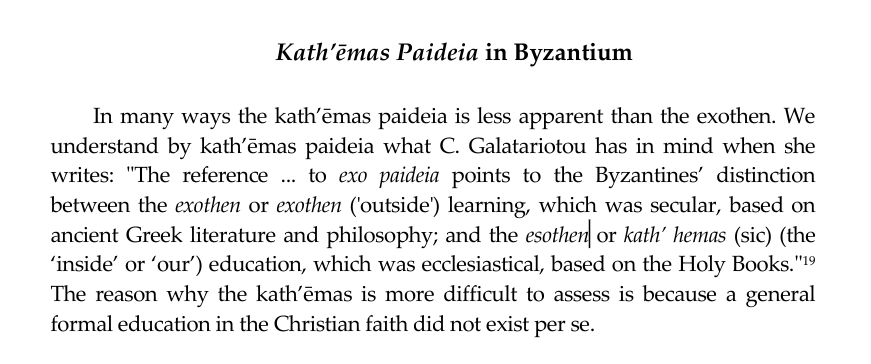
A helpful *moderate* view is that of Byzantine Education, as articulated by St Gregory Palamas [6][7]:
[6]: https://www.athensjournals.gr/history/2020-6-2-1-Penney.pdf
[7]: https://thephora.net/phoranova/index.php?threads/programming-as-we-know-it-will-disappear-this-year.1975/#post-21143 (discussion with [USER=58]@Vladimir[/USER])
I would add that my own ultimate intent, though not in this thread, is to do for philosophia physiki what Dugin has done, in his trilogy, for political philosophy in an Orthodox Christian, and indeed Palamite context, which is to say, given a response according to Tradition (esothen) and Traditionalism (exothen). [8]
A necessary preliminary task is to trace Modern Science, not only back to say the Ramism of Descartes or even Nominalism/Conceptualism of Occam and even Peter Lombard, nor even to trace the ‘History of [Modern] Science’ to its incorporation of Hermeticism and the Western Esoteric Tradition [WET] so familiar to Guenon or Hobbes/Bacon, but to restore the Gymnasium as a tool of right-teaching *secular* philosophia. What has Jerusalem to do with Athens?
The only reasonable path to this project is to reconstruct the presence of Latin Scholastic philosophy from the 12th century on, as the *driving* force behind Modern [Western] Science, and *then* to relate, in that context, all the Western traditions to the GREEK Scholasticism from which they are both derived, and in the 13th century of the Latin Occupation, grew together one last time. This pushes ‘the story’ back to the 3rd century and even before the immanent rise of Neo-Platonism as a philosophical current. This is not so much an exercise of academic history, as a philosophical understanding of the place of the Platonic and Aristotelian tradition in Orthodox Christian culture.
We find indeed that ‘Neo-Platonism’ provides a framework for understanding the shared Traditions of the ‘People of the Book’ — as it is common to the Christian civilisations, however many of those there are, and likewise of Islamic civilisations, however many of *those* there are, and certain forms of Judaic Scholasticism, with in the matrix of both sets of civilisations. In some ways, this observation makes workable the proposals of Alasdair Macintyre, in his ‘Trilogy’ that starts with _After Virtue_ (and to which he has since added a fourth, explicitly Thomist, work).
[8]: In the above senses, both the political and the physiki discussions are related, as probably Dugin would aver, and what is needed is a re-articulation (my opinion now) for Orthodox Christians in our time (I would say), of both /our/ paideia (esothen), and the right use of philosophia physiki (exothen) in doing Physics — that is, theoretical and practical Biology, Chemistry, and Physics in the modern, narrow sense of it, which is to say in the Aristotelian framework.
Leave a Reply